Saturday, August 11, 2012

The Sound of Scissors

It was the last week of my summer programming up in the city and it was quiet.  Really quiet.  I had never seen such a large group of five- to nine-year-olds so collectively intent on something.


Maybe it was the stories I had just told them about my square friends (documented in detail here).  Those squares were incredibly jealous that the hexagon in the middle of our space had transformed himself overnight with some yellow tape. I mean, come on!  Everyone needs a change of pace once in a while, why couldn't the squares try it too?  After a little folding, a little cutting, each square was thrilled with their newly transformed, and utterly unique, paper selves.  I put them up on display so they could show themselves off.

When it was the kids' turn, they took their scissors, glue sticks, and paper and went for it.  I didn't do much else other than remind them of how I folded the paper during the stories and tell them they could have as much paper as they needed to experiment and make mistakes. 

Once they had a design they liked....


...they could glue the transformed square onto another square of a different color. 


When they came to me with three or four designs I asked them to put them in an order that they liked, or that made sense to them.


Even when their scissor skills were not the greatest, the overall effect was really fun and amazing.  It's obvious that they tried different things each time.


And, my favorite thing about letting kids explore a medium: the activity, but also not the activity.  This boy devised a layering technique that looks incredible.


And then there was the five year old boy who cheerfully adapted the activity for himself.  The red square was the first effort (so lovely) and by the second square he had fashioned something completely different. 


Ultimately, it was probably 35 minutes of focused concentration.  All you could hear was paper being folded and the sound of scissors.  Now that is the kind of quiet you want in math class -- not the stuck, frustrated kind, but the kind where kids are intrinsically motivated to find solutions and discover structure all by themselves, one cut at a time.  Just listen:

Friday, August 3, 2012

More Than Red, Blue, Red, Blue

First, a little context.  I've just finished four days of hands-on workshops for a summer camp of kids ages five to twelve.  Our hour-long, mixed age classes have been full of rhythm and patterns in the feet as well as exploration of other kinds of patterns including ones we can find in nature (Fibonacci numbers, hexagons in bee hives, etc.).   I've also told some stories about squares who are completely bored with their straight edge/sharp corner existence who want and need a change. (See a version of these stories in a recent post called Scissor Stories: Tales of Transformation.)

This kind of summer programming up in the city finds me working with kids whose backgrounds I know nothing about.  I don't know where they came from or where they're going, so I mostly just try and go with the flow, try to meet them every day where they're at instead of where I think we should be. 

Although grant sources require some 'evidence' of learning or growth, my job is to do the best I can in four days.  To the kids I describe our work as using and making and understanding patterns of all kinds, and we spend most of our time doing just that; instead of explicitly talking about patterns, we're just trying to make and use them.  As a result, kids may or may not have absorbed new vocabulary to use when it's time to assess their learning on the final day.  I think my goal is simply that they have a reserve of experience to call on when they're back in school learning math with their paper and pencils.

But, like I said, I still need to ask them questions at the beginning and at the end.  Here are the questions I asked this week.  I'm still not sure that the first question is a helpful one for assessing learning but, as you'll see, it did provide me with some very interesting information:

Question One: "What is a pattern?"

First of four days, summer camp children ages five to twelve: 
Something that is ABB and it keeps going...
Two or more things on paper...putting it on paper over and over.
Square then rectangle, keep going.
Repeats.
Something that gets put together.
Different colors.
Numbers -- 1, 2, 1, 2...

Last day:
Numbers, shapes
Rhythm
Nature
Sequence, repeating.
Heel, heel, toe, toe... (a clogging step)
Circle, circle, square, hexagon (We studied a hexagon as one of our nature's patterns inquiries.)
Take things and put them in order.
You know it's a pattern when it's the same, something that repeats, like red, yellow, red, yellow...

Question Two: How can you make patterns with your feet?

First day:

Different kinds of shoes and socks.
Switch shoes.
1,2,3 on one foot, 1,2,3 on the other foot.
Bang them.
Mix with other people's feet.
Big foot, small foot...
(Alternate) movement.
Switch shoes.
Number of taps.

Last day:

Steps, slides, jump, turn.
(Use directions) left right front back diagonal.
(Put your feet) together, split, crossed.
Big, small, big, small (movements)
Heel, heel, toe, toe (a clogging step)
Sounds
Use toes, heels, kicks.

It's heartening to see that the answers to the second question showed much more understanding after four days of dancing.   As for the first question, it's clear to me that, even after four days of playing around with patterns, the idea of pattern these children (and pretty much every other child I've seen this summer) have internalized is a very narrow conceptualization limited to colors and shapes that repeat in a linear way one after another, almost always "on paper." 

Driving home today (it's over an hour each way) I had a lot of time to think.  I was thinking of all the ways we can harness kids' love of doing and making in the elementary years to the goal of engaging in an deep and meaningful exploration of patterns of all kinds.  And that, in the the process of this kind of exploration, kids would get a chance to represent and experiment with this oft perceived 'simple' concept in a multitude of ways: 2D on the page (so many ways to do this), 3D with their bodies as well as all the great math building materials out there, and even 4D using time and rhythm. 

While I drove I also had a lot of questions in my head: How can kids learn to see patterns in numbers if all they know is 'red, blue, red, blue'?  How can they understand what patterns are if they don't have personal experience with constructing them, taking them apart again to explore the pieces, and transforming them into something completely different?

I am certain it is possible to provide deep, meaningful, artistic, open ended explorations of patterns at the elementary level.  We do it all the time in Math in Your Feet with percussive dance; I am starting to understand how I might move this approach toward other mediums.  (To see a really nice curated collection of math art, go to the Math Munch blog.)

I have a lot more thinking and learning to do on this topic, but for now I'm clear on one thing:

Almost every one of the 180 kids I encountered this summer, no matter their age or their dancing ability, were unable to identify or describe patterns outside the standard textbook context.  I think they can handle more.  Not only that, I think they want more. 

Tuesday, July 31, 2012

Like Bees to Honey

I'm at my final program site up in the city for this summer.  Every day we work with Jump Patterns for a while, learn some clogging and then it's time to sit down for a while and explore other kinds of patterns.  Nature's patterns, to be exact!

A couple weeks ago, at a different site, the kids got so excited about finding a 'nature's number' (Fibonacci!) inside an apple that I had to go out and buy a bunch of lunchbox apples and cut them in half so everyone could have their own apple star the next day.  I've never seen kids so excited about numbers, or apples for that matter. 

I did my apple 'magic trick' again yesterday, but for today I decided to focus on shape and design in nature.  First I taped out a pretty respectable hexagon on the floor in the middle of our dance space.


When it was time, I asked the kids if they knew what shape it was.  The older kids knew, but not the youngers.  (At this site I have five to twelve year olds in the same class.) 

I asked how many sides a hexagon has, but before I'd allow an answer I started asking for volunteers to stand at each of the sides.  "One child, one side," I said, "Who wants to stand on the next side?  Okay, two children, two sides..." and counted up from there. 

I picked the little kids on purpose since they had been the most challenged with the dancing. 

"Okay," I said, "Everyone put your arm in."  I guess I wanted there to be some sense of division of the space.  Tomorrow I'll got back and put down more tape to show some of the internal structure of this hexagon.


"How many corners does a hexagon have?  One child per corner...Oh look!  Six sides, six corners!"

Then each kid got their own pattern block hexagon, or two trapezoids, to add to the tiling I started.


"What can you find in nature that looks like this?" I wondered aloud.  Only the last class (with more older kids in it) knew right off the bat.


Then they got their very own taste of local honey.  It was a bit too strong a taste for most kids, but still a good new thing to try.

And then, much to my delight, something wonderful happened.  My first class was waiting to go on to their next workshop and were hanging around in the space.  They naturally found their way to the hexagon on the floor, made a circle around it and started playing song and chant games.  This is exactly the kind of thing that always happens when I put down tape where its never been before.  It changes the space and kids notice.

Another example from earlier in the morning: I was creating a set of parallel tape lines as I measured out the sides for the hexagon.  A little boy came over and jumped over the width and then the length.  I wish everyone would put tape down on the floor and then start the camera rolling to record all the awesome things that happen when kids discover this restructuring of their world.

This much I know: kids are to tape as bees are to honey.  Or maybe that's bears to honey?  Anyhow, here's the video of the girls playing 'Little Sally Walker' around the hexagon waiting for their next class:

Sunday, July 29, 2012

Sumptuous Saturday | Treasure Map Math

It was the perfect, perfect, perfect Saturday, for math and just about everything else.

After months and months of cruelly hot weather with muggy 80 degrees by 7am every day, one recent Saturday morning we woke up to 60 degrees, a clear blue sky, and even some mist.

The kid and I walked the two-plus miles downtown to the Farmers' Market via a paved trail that runs miles through our little city.  Lucky for us and our walkabout math habits, the lamp posts on the trail are numbered.  I was considering musing aloud what the half of each number would be when the kid spontaneously starts marching and, along with this steady rhythm, she starts to chant: "Eight plus eight is sixteen. Sixteen plus sixteen is thirty-twooooo.  Thirty two plus thirty two is six-ty-four!  Sixty-four and sixty four are...hold on...[pausing, eyes unfocused, obviously concentrating internally] ... one hundred twenty eight! [marching resumes] One hundred twenty eight plus one hundred twenty eight are..."

I don't remember how it went at that point.  We've not really done mental addition that high, but she made some mighty efforts nonetheless.  And, as we still had a ways to go, she started a couple more rounds of doubling, one starting at fourteen.  The other I can't recall.

We finally arrived at our destination and and found our friend L whose parents have a booth at the market.  Have you ever had lemon cucumbers?  Theirs are divine.  Directly after we found him, we also found a banjo!   Here's a quick video of the movement that ensued:


My kid has been wanting a waltz partner for like forever.  I'm not sure L. knew what hit him!  And, as for dance (and math) my kid seems comfortable in the phrasing and ratios of a number of time signatures, 3/4, 4/4 and cut time included. 


We then moved on to other regular market activities, like meeting the kitties from the shelter.  No math there, but I suppose someday we'll find it.


There's a lot of great spiral math in the fountain outside city hall.  No water in it this day, but kids regularly start in the center and splash spiraling outward, or float bark boats in the reverse direction.  The spiral actually opens way up on the left there, meandering in curves around until it meets the actual fountain.


And, although the water in the spiral fountain had been turned off for some reason, it didn't stop the kids from playing.  Apparently my girl and L. had been searching for big and interesting pieces of birch bark on the ground when she ran over to me all excited about finding a map of the fountain drawn in pen on the bark "with an X on it!"   Of course, that had to mean treasure was close by. 


And, of course, they started trying to follow the map (surprisingly, almost to scale) of the fountain area.  They got completely engrossed in figuring out how to read the map to find the location represented on the map by that curious X.

At some point they recruited another girl, maybe older?  It's hard to tell because my kid is pretty short for her age.  Even L. who is a year and half younger is half a head taller than her.  Anyhow, they pondered, and searched, and retraced their steps over and over.  After about fifteen minutes I realized that they were looking for an actual X on the ground.  At that point I stepped in and wondered aloud whether someone who had hidden treasure would want to mark the spot on the ground or not.  I mean, really.  If you've got treasure you really don't want anyone to know about it, right?

The three kids finally decided they knew the exact place where the treasure was buried and I had to agree.  They had done a perfect job at reading the map but couldn't find anything.  The finally decided the treasure was under the cement trough somewhere and inaccessible.  A little downcast, but ever perseverent, they moved away from the spot to talk some more about the whole situation.

At that point I figured that, if they had spent over twenty minutes working together to analyze the map and the territory and actually succeed in pinpointing the exact spot (not to mention collaboratively analyzing the potential motives why someone would leave a map behind) they should be rewarded in some way.  Being short on change I petitioned bystanders who had been watching the proceedings with interest.  Between us I got three dimes and three pennies.  I made sure the treasure hunters weren't looking and poked the change into the dirt.  Then I said:

"Hey, guys!  Weren't you just over here?  Come here, and take a look.  I think I might see something..."

My bystander friends were looking on at a distance and we all just beamed at how excited the kids were to find their treasure.  They figured out how to divide the money equally.  I'm not sure, but they may have wondered why it wasn't more than 33 cents but that didn't stop them from telling their story over and over to anyone who would listen.

You know, the story about The Day -- the day they followed a found map to buried treasure on city hall grounds.  Perfect.

Friday, July 27, 2012

Math By Design: Paper Patterns

Summer programming has given me some room to experiment with ideas that have been brewing over the last year.  Ultimately, I designed three new non-dance making activities that reinforced the Math in Your Feet ideas of creating a pattern unit using multiple categories of attributes.  My favorite by far, especially for its flexibility with a range of ages, is this paper patterns activity.

If you've scrolled down already you'll probably be thinking that it looks a lot like a paper quilt activity.  It is, sort of.  What distinguishes it from other paper quilt activities is that there is no pattern to follow, only some guidelines to direct the design process.  Because there's been a day or two at each site this summer where dancing was just not an option -- too hot, too crazy, too distracted by thoughts of swimming after class, whatever -- this quieter activity has been perfect at reflecting and reinforcing the dance work we've been doing on other days.

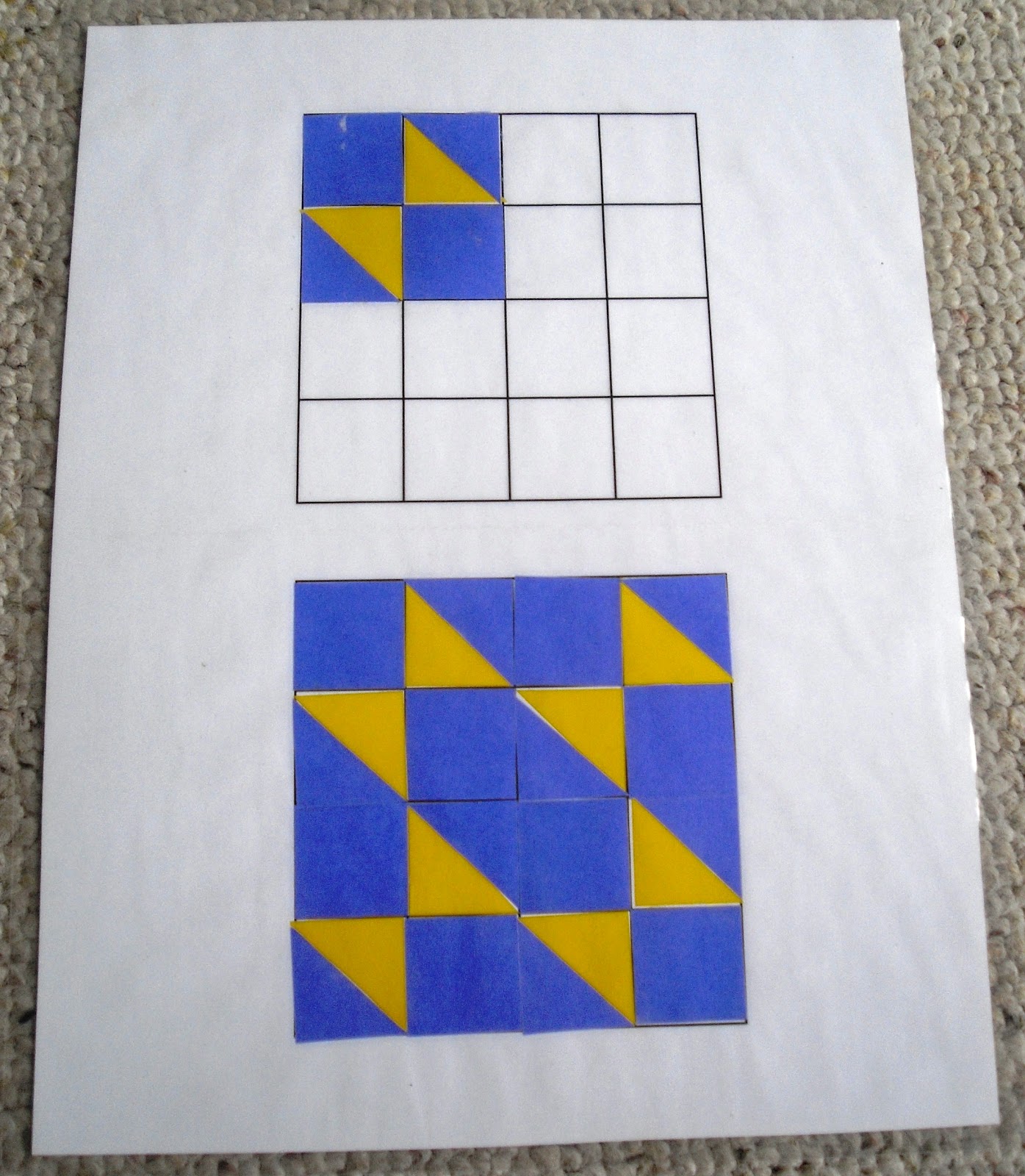
Just as with the dance work, the individually designed paper pattern unit is made up of four pieces (beats in the dance, squares in the paper design) with choices of various attributes.  The pattern unit is then repeated, or joined with a different design, to make a larger pattern, revealing complexity in combination.  Here's how I introduced the activity at my first summer site:


The idea was to experiment with different four-square designs, using a combination of squares and triangles.  At that point the kids would pick their favorite pattern unit and then repeat that favorite four times in the sixteen square grid, as pictured above.

This turned out to be confusing for the kids at the first site.  They were on the younger side (ages seven, eight and nine), most of them emergent or beginning readers.  This, in itself, is a clue as to the importance of an activity like this. A pattern unit is comprised of various smaller parts that make a larger whole.  In math this is called 'chunking' and is a crucial skill for algebra down the line.  If a child has not yet learned to 'chunk' words, they will also most likely benefit mathematically and in their reading from the challenge this activity provides. 

Unfortunately, it was a crazy site, and I didn't have the time or the support to help individual children the way I would have liked.  Since this was the first time I had tried the activity, I didn't anticipate some of the issues that came up.  For example, the kids had too many color choices and ended up using all of them.  It was okay to have four, five or six colors in one, four-square design, but when it was time to repeat the pattern unit, it was much too hard for them to slide the design over or down to repeat it in the grid. 


There was some interesting experimentation with the triangles and squares, though, which is always good in my book.


Do you see what I mean about too many colors (design on the left, specifically)?


Here are two kids who figured it out:


Well...sort of. 


By the time I got to my second site I had adjusted the activity.  I split the sixteen square grid into four smaller, separated parts, and when they had created a design they liked on that sheet I gave them the larger grid. This helped focus kids on the individual unit itself and then make the transition to the larger grid.


The kids at this site were also older (nine, ten, eleven, even twelve).  This time around I decided to limit it to a choice of two colors which I think helped focus the activity tremendously.


This design is a little out of the box, but it doesn't surprise me as this girl was the only one to use a combination of turns in the dance patterns she created.  Her brain was already 'there' if you know what I mean.,


This final picture sums up why I love this activity so much.  Small, simple pattern units get combined to make something surprising, beautiful and mathematically interesting.  The elements of personal choice and action on the design process creates unique results for each child.  Just like in Math in Your Feet.

And the math?  Flips, slides, turns.  An inventory of attributes.  A problem solving process.  Grids.  Patterns. Attending to precision. Just like in Math in Your Feet!

Most importantly, the idea of pattern unit and the concept of chunking is reinforced throughout the entire activity.  And, if they can do it, great!  If they can't, you first and foremost find the beauty in their efforts.  It is this personal work, full of thought and energy, that becomes a self-generated incentive for moving forward to the ultimate goal.  Not only does this activity allow you to celebrate the individual efforts of each child but also makes it easy to immediately assess where the learning points are -- because the evidence is right there in front of you! 

LinkWithin

Related Posts Plugin for WordPress, Blogger...