I had a very interesting conversation with my eight year old over math homework this morning revolving around the commutative property. Interesting because of her thoughts and also interesting that, for the very first time, I backed away from mathematical correctness, and truly listened to what she had to say. It was fascinating.
The homework asked for factors of various two digit numbers. For 24, my kid put 2x12, 1x24 & 24x1.
I said, "Those last two are the same thing, what other factors can you figure out?"
The response was immediate and somewhat intense. She was convinced that 1x24 and 24x1 were different because that is what the teachers said.
I mentioned we had read about the commutative property in Beast Academy 3B but, sweetly, nothing could sway her loyalty to her teachers and her opinion about what she thought they had taught her.
It was at this point I thought back to all the things Christopher Danielson has written about Cognitively Guided Instruction and the wonderful modeling of his Talking Math with Your Kids project. These approaches show the worth of conversation around math with an emphasis on the adult really listening to what the child is thinking.
She continued. "See! One times twenty four is [pointedly counting] one, two, three, four, five, six, seven, eight, nine, ten, eleven, twelve...twenty four. Twenty four times one is...[pausing, then saying emphatically] twenty four."
I nodded. "Oh, I see what you're thinking. The first way means you have to count by ones 24 times. The second way you just have to say 24 once."
In her mind it's the process of getting to the final answer that makes the two facts different. Never mind that she gets the same answer both ways. Never mind that she knows all about the "twin facts" on multiplication chart. Never mind that we're having fun finding different ways to memorize multiplication facts including sneaky guerrilla tactics. Nope. This is her reality and it's not going to budge by quoting official definitions.
All I said was,"You can put those two facts on the paper, but your teachers may want you to put some others as well." In the end she found all the factors of 24, but wrote each combination twice (e.g. 6x4 and 4x6).
In the process of writing my new book, tentatively titled Meaning in the Making: The Body Learning Math, I've been doing a lot of reading and thinking about how the processes of doing and learning math are just as important as the product. In this case, she can easily figure out factors of two digit numbers, but it's by watching her process closely and engaging in conversation about her thinking where we really get a glimpse into what she knows and how she knows it. Specifically, we can see how she is literally making and reasoning out her own meaning of how multiplication facts are combined.
We only get half of the picture if we look at the final product/answer (double facts). I know how to watch for and identify understanding through the processes of making math and dance at the same time, but now I'm really learning about how it works with numbers, too! Fun stuff.
Showing posts with label multiplication. Show all posts
Showing posts with label multiplication. Show all posts
Tuesday, January 14, 2014

Tuesday, September 24, 2013
Stake Your Claim
My daughter's 3rd/4th grade class has been working on arrays over the last few weeks. (I recently found out they are using the TERC Investigations curriculum, which seems really strong. Arrays are the first investigation for the 4th grade sequence.) One of their homework assignments was to find, draw and quantify examples of arrays in their environment at home and at school. Of course, I love that!


Wanna' play? Here are the files! Please do let me know how it goes and what modifications/improvements you made to the execution, or any design suggestions you might have.
It reminded me of a game I created for my daughter and I to play in the spring of 2012. The post about the activity is called Totally Territorial: Cats, Maps, Area & Multiplication.
Essentially, I drew a grid over a map of our fair city and, armed with dice and some pens, we staked out our claim. It was totally fun and my almost-seven-year-old was completely into it.
Since they are in the middle of a world geography unit (meaning maps!) in addition to their array inquiry I thought it might be fun to formalize the game for the class. I searched for 'maps of imaginary places' and found a bunch at The Explorer's Notebook, created some grids and a game structure and....voila!

The game right now has five maps. The rules are simple, but I think the narrative context provided by the maps is enough to make this fun:
Purpose of the Game:To capture as much area on your map as possible.
Rules of the Game:
2 players
Roll one dice to determine who starts the game.
Roll one dice. First roll determines the number of horizontal squares/length. Second roll determines number of vertical squares/width (include the first horizontal row in your count).
Outline or highlight your full array in your chosen color. Compute total area (total number of squares) for each turn.
Game is over when all territory is captured or both players have both had two unsuccessful turns (meaning not being able to find enough area to capture based on their roll). Player with the most territory/area wins although you may want to consider the value of land vs. water in the final value of area claimed.


They played it today (while I was working with small groups working on half-ness, midpoints, congruence and three-ness with this Sierpinski Triangle activity from The Fractal Foundation). Their teacher said they were all completely into it for the entire math class. From what he overheard, it was unclear if the kids had developed any over-arching strategy at this point. More likely, he thinks, they were simply enjoying rolling the dice, computing the area, and capturing territory.
I know I'm not on the cutting edge of game design, but the fact that 27 kids were happily engaged in mathematical activity for almost an hour probably says a lot. The teacher and I did discuss upping the difficulty by adding a rule about only being able to add territory attached to previously won territory. I love the idea, but think you'd need a bigger playing area for that.
Monday, September 16, 2013
Second Math-y Monday...
The first Math-y Monday was a big hit! The kids in my daughter's 3rd/4th grade classroom are still working on their archetype times tables. I'm hoping I'll be able to take some good photos of their work. Stay tuned.
For the second Marvelously Math-y Monday I am bringing in an extra Multiplication Models poster from Moebius Noodles that I had lying around (and the poster itself can be purchased here -- they're seriously gorgeous in real life).

And, because one of their teachers introduced them to magic squares last week (cool, huh?) I thought I'd bring in this book to add to their library:

It's going to be a great Monday!
For the second Marvelously Math-y Monday I am bringing in an extra Multiplication Models poster from Moebius Noodles that I had lying around (and the poster itself can be purchased here -- they're seriously gorgeous in real life).
And, because one of their teachers introduced them to magic squares last week (cool, huh?) I thought I'd bring in this book to add to their library:
It's going to be a great Monday!
Tuesday, September 10, 2013
Making and Playing Math with Kids: Day One
This was Day One of hopefully many more in which I get to play and make math with kids while simultaneously fulfilling my parent volunteer hours in my daughter's 3rd/4th grade classroom.
Group #1 | 20 minutes

"So, here's something. Math isn't just about numbers, it's about finding patterns. If you get one rod of each color I wonder what kinds of patterns you'll find?"


"How many whites make a red?
"Two..."
"So, if white is worth one, how much is green?"
"What do you mean?"
"Well, if red is two whites, and you add another white, how many is that?"
"Oh! Three! Green is three!"


What's awesome is that these designs were made by the kids whose relationships with written numerals are not happy ones and yet, it's not for a lack of ability in noticing patterns or structure. At the end of this session they all left with smiles on their faces, saying "That was fun!" We will continue with colorful and visual math because it's fun and I am fairly confident that this process, in the end, can be helpful in shoring up that bridge between mathematical meaning and symbols/abstraction. p.s. This bin of Cuisenaire rods is now on their game shelf for free-time play with the following label:

Group #2 | 20 minutes
Group #2 came in buzzing. Their teacher had given them the two different multiplication charts I had laminated for every student and they couldn't stop talking about the archetype times tables from crebobby.com. (See my post Marvelously Math-y Mondays for all the details and links).

When they settled down I ran them through a slow game of Speed! which is a super fun game created by Highhill Homeschool. I'll write about it more later but my biggest observation was that just because kids know how to skip count, doesn't necessarily mean they can quickly think "4 more" or "4 less" than any number in that sequence. This game seems to support more flexible thinking about multiples and is now on their free-time activity shelf as well. As a group they had experience with 2- through 5-speed but I hope they will persevere into the higher numbers. If not, I'll make something happen the next time we meet. Yay for challenges!
Back in the classroom, I guess the enthusiasm for the archetype times tables had become unbearable and their teacher had to hand out the 'make your own' sheets I created. His biggest goal/hope, I think, was for them to become more familiar with how a grid works in combining/multiplying numbers.

I think this make-your-own thing might have helped a lot in terms of learning to track rows and columns!


Energy and enthusiasm during math time! It makes a heart glad.
Group #1 | 20 minutes

"So, here's something. Math isn't just about numbers, it's about finding patterns. If you get one rod of each color I wonder what kinds of patterns you'll find?"

"Can you describe what you made?"
"Well, the underneath one goes biggest to smallest and so I reversed it on the top."
"How many whites make a red?
"Two..."
"So, if white is worth one, how much is green?"
"What do you mean?"
"Well, if red is two whites, and you add another white, how many is that?"
"Oh! Three! Green is three!"

"What kinds of patterns or designs can we make using only the first five rods: white, red, green purple, yellow?"

"Your design looks like it's the same on both sides. Can you tell me more about how you made it?"
"Well, I started in the middle and built out."
"Hey everyone, come here! What do you notice about the pattern that is showing up on this design?"
"I see those white blocks in every corner."
"How do you describe that line running from corner to corner?"
"Diagonal!"
"Okay, one minute left. Time to clean up!"
"Awww...I just gotta put down one more block..."

What's awesome is that these designs were made by the kids whose relationships with written numerals are not happy ones and yet, it's not for a lack of ability in noticing patterns or structure. At the end of this session they all left with smiles on their faces, saying "That was fun!" We will continue with colorful and visual math because it's fun and I am fairly confident that this process, in the end, can be helpful in shoring up that bridge between mathematical meaning and symbols/abstraction. p.s. This bin of Cuisenaire rods is now on their game shelf for free-time play with the following label:

Group #2 | 20 minutes
Group #2 came in buzzing. Their teacher had given them the two different multiplication charts I had laminated for every student and they couldn't stop talking about the archetype times tables from crebobby.com. (See my post Marvelously Math-y Mondays for all the details and links).

Back in the classroom, I guess the enthusiasm for the archetype times tables had become unbearable and their teacher had to hand out the 'make your own' sheets I created. His biggest goal/hope, I think, was for them to become more familiar with how a grid works in combining/multiplying numbers.

I think this make-your-own thing might have helped a lot in terms of learning to track rows and columns!


Energy and enthusiasm during math time! It makes a heart glad.
Saturday, September 7, 2013
Marvelously Math-y Mondays
Shhhh...don't tell my kid's teachers but today marks the inaugural installment of Marvelously Math-y Mondays. Yes, I know I'm posting this on Saturday, but I just couldn't wait!
On MMM's I plan to bring something math-y to my daughter's 3rd/4th grade classroom to inspire wondering, noticing, questions and conversations. I'm kicking things off in style with two variations on the classic multiplication table and one make-your-own version.


On MMM's I plan to bring something math-y to my daughter's 3rd/4th grade classroom to inspire wondering, noticing, questions and conversations. I'm kicking things off in style with two variations on the classic multiplication table and one make-your-own version.

I put the times tables back to back and laminated them so they will stay fresh all year round in the kids' math folders.
One side is this very graphic and beautiful visual, to scale, multiplication table which I found last year at Let's Play Math (at the end of her post, but the post itself is marvelous as well). This chart has been hanging on our wall all year and I'm still not tired of looking at it.
And here's a closer look at the other side, one of the archetype times tables from crebobby.com:
And here's the make-your-own version I put together (revised thanks to the astute observation from Denise in the comments):

Have a marvelously math-y Monday! How will you marvel over math today? Let me know!
Thursday, April 4, 2013
Colorful Math: Area, Multiplication and Square Numbers Edition
Two things our house has a lot of: math and color.

We eat colorful, mathy breakfasts. (Isn't this hexagon egg-citing?)

And then we work on our colorful and original attributes matching game. The attributes include a multitude of choices in the following categories: shape, color and pattern. We ask: How can I make the pair exactly the same? How can I make the next pair different? How are my designs similar to each other?

After a bath and second breakfast, we learn about square units and determine the size and area of each picture. But why stop there when there are colored pencils around? I wanted to move on but quickly concede that not only is color is a great addition for highlighting structure within the areas in question, but basic math gets a whole lot more fun to do!

At which point I think: Wow, I've got some graph paper...how about tomorrow we look into square numbers?
And how do I start that lesson? Pick your seven favorite colors!

We do the first six numbers and the child, unbidden, suddenly looks over her work and says "Wow, they get bigger! Oh, and there's a pattern!" We figure out the specifics and then use that observation to predict the seven square. I know there is lingering confusion about how exactly that number is made but, as you know, tomorrow is another day and I think I have an idea...involving colored pencils, of course.

We eat colorful, mathy breakfasts. (Isn't this hexagon egg-citing?)

And then we work on our colorful and original attributes matching game. The attributes include a multitude of choices in the following categories: shape, color and pattern. We ask: How can I make the pair exactly the same? How can I make the next pair different? How are my designs similar to each other?

After a bath and second breakfast, we learn about square units and determine the size and area of each picture. But why stop there when there are colored pencils around? I wanted to move on but quickly concede that not only is color is a great addition for highlighting structure within the areas in question, but basic math gets a whole lot more fun to do!

At which point I think: Wow, I've got some graph paper...how about tomorrow we look into square numbers?
And how do I start that lesson? Pick your seven favorite colors!

We do the first six numbers and the child, unbidden, suddenly looks over her work and says "Wow, they get bigger! Oh, and there's a pattern!" We figure out the specifics and then use that observation to predict the seven square. I know there is lingering confusion about how exactly that number is made but, as you know, tomorrow is another day and I think I have an idea...involving colored pencils, of course.
Saturday, March 30, 2013
A New Math Song Before Bed (Video)
So...who likes bedtime? I, for one, am not generally enamored with detours from the normal bedtime routine.
But when my kid said, "Hey Mama! Want to hear this song I made up that helps you with your three times table?!" I decided to give her a little leeway so I could capture the moment. What can I say, I'm a sucker for math!
The song starts: "There were three ice cream trucks at the corner of Circle Drive..."
My favorite part is 'on the corner of Circle Drive' since, of course, circles have no corners! But, I'm pretty sure this was not intentional on her part.
Did see her looking off to her right to silently skip count the answers in her head? We've been doing a lot with conceptualization of multiplication/division (arrays, multiplication towers, factor dominoes, scale, re-imagined factor trees, exploring the concept of units) but almost nothing with memorization.
I'm happy to have this unexpected piece of evidence that she is thinking about and internalizing these concepts. I'm also pleased to report a happy conclusion to bedtime!
But when my kid said, "Hey Mama! Want to hear this song I made up that helps you with your three times table?!" I decided to give her a little leeway so I could capture the moment. What can I say, I'm a sucker for math!
The song starts: "There were three ice cream trucks at the corner of Circle Drive..."
My favorite part is 'on the corner of Circle Drive' since, of course, circles have no corners! But, I'm pretty sure this was not intentional on her part.
Did see her looking off to her right to silently skip count the answers in her head? We've been doing a lot with conceptualization of multiplication/division (arrays, multiplication towers, factor dominoes, scale, re-imagined factor trees, exploring the concept of units) but almost nothing with memorization.
I'm happy to have this unexpected piece of evidence that she is thinking about and internalizing these concepts. I'm also pleased to report a happy conclusion to bedtime!
Monday, February 18, 2013
Seeing Numbers
I've been thinking on and off about ways to help my seven year old daughter come to know, appreciate, and maybe even love numbers. Geometry is easy for both of us because it's visual. But because my math schooling was of the memorize and drill variety I have really had to stretch myself in order to make my daughter's early experiences with numbers more meaningful than mine were. As it turns out, I'm learning a lot in the process and, as a bonus, I am finding that numbers are quickly becoming an unexpected but welcome gang of amusing little friends.
Since we're working on conceptualizing multiplication and division these days through various explorations, I thought it might be fun to make 'number cards' to visualize one number at a time. Using coins (and clarifying their intent as reconciled in my recent post on units: When is a 10 Not a 10?) we looked at all the different ways to split 25 and found lots of remainders. I suggested 60 after we read that base 60 was popular early on because it can be divided in so many ways.
As you can see, the results are less than inspiring and it's not clear to me that the child really learned anything more from making the cards in addition to the array work with the coins.

These cards are still taped up hopefully on the wall, but I had basically abandoned the project...until I saw this fantastic post from an international school in France that re-imagined factor trees in the most awesome way. Isn't this the most lovely factor tree you've ever seen? And there are more -- all as beautiful as this one. Their project in France has inspired us here at home and has become a perfect and flexible solution for our nascent number wall idea:

I showed the girl the post that inspired me and she was entranced and eager to get started. She is doing well with hands-on and mental multiplication and division, but factoring as an activity is new to both of us and so I decided 20 would be a nice easy number to start with.
We took out the Cuisenaire rods and she found all the factors of 20 herself. She double checked every rod from 1 to 10 and noticed a lot during the process, skip counting as she went. "If I can use fours, I can use twos, too!" "Threes...no that makes twenty one...."

And then we wrote them out as equations and sketched a preliminary tree. And here is where this activity became as important for me as it was for her. I do not recall in all of my fourteen years of school mathematics (including those awful matching bumblebees in kindergarten, my tenth grade algebra D, my tenth grade geometry A, and a deliriously confusing semester of college algebra) ever learning about factors. Ever. So, it took me a minute, but I made it work. (Oh, the things you do for your children!)

Then we got to work. We drew and we drew and she whistled a happy tune (literally) for over twenty minutes. She would not let me look at her work. She was in heaven. This is what she finally unveiled to me:

To me, it's glorious. Even though it's not a factor tree, per se, it shows so much of how her 7 year old self is thinking about numbers, including an emerging understanding of factors. All the numbers she wrote are obscured by the coloring, so I had to ask her about them. At its base are the numbers 10, 10 and 20. Notice the overall symmetry of the tree. The flowers at the base are 5+5+5+5 (do you see the 'plus' sign written on the trunk?) and, even better, the colors are inverted in each pair. Moving up the tree, the next two longer branches on the outside are 2 and 10 (so 10x2) and the two small branches inside them are both 10 (so 10+10) and the crowning flower is 20!
This tree motif is doing so much more for her visualization of numbers than those little cards ever could!! I'm so excited.
And, as a little bridge to future trees, after she walked me through her drawing I showed her mine. I asked her what she noticed and what the differences were between the trees.

She noticed a lot, but not the numbers so I pointed her attention to the fact that although each tree split in different ways (10 and 2, 4 and 5), they still had the same prime flowers -- two 2s and a 3. (Did you notice I made each prime it's own color? And I wonder if there are other ways to bring out the number properties beside just writing the numeral?)

There is no need for us to rush into full-out factoring, but it is an interesting exploration and variation on the division we've been doing. And, the introduction of another type of number, the primes, is an interesting development as well. I think this is an approach that we will be able to use time and time again: create, observe, discuss, posit, repeat.
Let's see: trees as metaphor. I've seen fractal trees, factor trees, and trees whose branches are the positive numbers and roots the negative ones. There is so much potential in this kind of image/metaphor for number explorations through all elementary grades. And, you do know that part of this approach is giving kids an empty piece of paper, some awesome pens and letting them create their own trees from the ground up, right?
I know one thing for sure: our number wall is going to be gorgeous!! [Addendum: Here's what happened the next day.]
Since we're working on conceptualizing multiplication and division these days through various explorations, I thought it might be fun to make 'number cards' to visualize one number at a time. Using coins (and clarifying their intent as reconciled in my recent post on units: When is a 10 Not a 10?) we looked at all the different ways to split 25 and found lots of remainders. I suggested 60 after we read that base 60 was popular early on because it can be divided in so many ways.
As you can see, the results are less than inspiring and it's not clear to me that the child really learned anything more from making the cards in addition to the array work with the coins.

These cards are still taped up hopefully on the wall, but I had basically abandoned the project...until I saw this fantastic post from an international school in France that re-imagined factor trees in the most awesome way. Isn't this the most lovely factor tree you've ever seen? And there are more -- all as beautiful as this one. Their project in France has inspired us here at home and has become a perfect and flexible solution for our nascent number wall idea:

I showed the girl the post that inspired me and she was entranced and eager to get started. She is doing well with hands-on and mental multiplication and division, but factoring as an activity is new to both of us and so I decided 20 would be a nice easy number to start with.
We took out the Cuisenaire rods and she found all the factors of 20 herself. She double checked every rod from 1 to 10 and noticed a lot during the process, skip counting as she went. "If I can use fours, I can use twos, too!" "Threes...no that makes twenty one...."

And then we wrote them out as equations and sketched a preliminary tree. And here is where this activity became as important for me as it was for her. I do not recall in all of my fourteen years of school mathematics (including those awful matching bumblebees in kindergarten, my tenth grade algebra D, my tenth grade geometry A, and a deliriously confusing semester of college algebra) ever learning about factors. Ever. So, it took me a minute, but I made it work. (Oh, the things you do for your children!)

Then we got to work. We drew and we drew and she whistled a happy tune (literally) for over twenty minutes. She would not let me look at her work. She was in heaven. This is what she finally unveiled to me:

To me, it's glorious. Even though it's not a factor tree, per se, it shows so much of how her 7 year old self is thinking about numbers, including an emerging understanding of factors. All the numbers she wrote are obscured by the coloring, so I had to ask her about them. At its base are the numbers 10, 10 and 20. Notice the overall symmetry of the tree. The flowers at the base are 5+5+5+5 (do you see the 'plus' sign written on the trunk?) and, even better, the colors are inverted in each pair. Moving up the tree, the next two longer branches on the outside are 2 and 10 (so 10x2) and the two small branches inside them are both 10 (so 10+10) and the crowning flower is 20!
This tree motif is doing so much more for her visualization of numbers than those little cards ever could!! I'm so excited.
And, as a little bridge to future trees, after she walked me through her drawing I showed her mine. I asked her what she noticed and what the differences were between the trees.

She noticed a lot, but not the numbers so I pointed her attention to the fact that although each tree split in different ways (10 and 2, 4 and 5), they still had the same prime flowers -- two 2s and a 3. (Did you notice I made each prime it's own color? And I wonder if there are other ways to bring out the number properties beside just writing the numeral?)

There is no need for us to rush into full-out factoring, but it is an interesting exploration and variation on the division we've been doing. And, the introduction of another type of number, the primes, is an interesting development as well. I think this is an approach that we will be able to use time and time again: create, observe, discuss, posit, repeat.
Let's see: trees as metaphor. I've seen fractal trees, factor trees, and trees whose branches are the positive numbers and roots the negative ones. There is so much potential in this kind of image/metaphor for number explorations through all elementary grades. And, you do know that part of this approach is giving kids an empty piece of paper, some awesome pens and letting them create their own trees from the ground up, right?
I know one thing for sure: our number wall is going to be gorgeous!! [Addendum: Here's what happened the next day.]
Sunday, January 27, 2013
Messin' Around with the Commutative Property
Malke Rosenfeld delights in creating rich environments in which children and their adults can explore, make, play, and talk math based on their own questions and inclinations. Her upcoming book, Math on the Move: Engaging Students in Whole Body Learning, will be published by Heinemann in Fall 2016.
We were at our second classroom (aka local co-op cafe) and just starting our project when a guy comes over and enthusiastically asked, "Can you tell me what you're doing?"
"Oh," said I, "we're building a multiplication tower."
"A multiplication tower? What's that?"
"Well, we've got these posts on a grid, and we are going to use different colored beads in different amounts to..."
And then he says, I kid you not, "Oh, yes, multiplication is just repeated addition, really." (Seriously, I'm not making this up!)
I was flummoxed, because after some great conversation about multiplication in the comments section of a post of mine from last March, and the aha! moment I had about scale while reading the Ten Times Better book, I know that's not all there is to multiplication. Not at all. I was so flummoxed it was all I could do to reply, "Well, it's also about understanding scale and measurement and rate..."
And just like that he cuts me off and says, "Well, this seems to be a good concrete way to learn addition..." (or something like that) and leaves, obviously much less enthused and impressed than when he came up to us.
And that about sums up the collective view of elementary mathematics, doesn't it? Essentially, the message we get is: "There's nothing much to it, just learn your facts and when you get a little older you can do real math [pat on the head]."
No, I'm not bitter, just perplexed, because when we started building this tower the questions started flooding in. I started wondering about a LOT of things, most of all the commutative property (which I inadvertently keep calling a process, and I think I might be on to something, see what you think.) Here is what we did:
I measured out a grid and my daughter and I inserted bamboo skewers into the intersections to make a total of 25 posts. Our first try at the tower grid was to start with one bead at the origin and then move outward on both the x- and the y-axes with two beads on the next posts, three beads on the next, etc. Here's a picture (isn't it pretty!?):

First, it's such a nice three-dimensional gradient, don't you think? And the different colors show the multiples of each amount clearly. But the questions started when we got through with 2 x 2 = 2 green + 2 red. Moving up to (1, 2) I suddenly thought:
"What colors should we use? Is that two 3s or three 2s???" It helped to see that the square numbers 4, 9, 16 and 25 moved up the diagonal and it calmed me a little to know that, whatever happened, we weren't completely on the wrong track.
It also helped to turn the model and look at it from different perspectives. This is a nice view because you get a linear progression of the colors. On the far left the posts increase by five: 1 five, 2 fives, 3 fives... and on the far right the posts increase by one: 1 one, 2 ones, 3 ones... This, incidentally, is the view my 7 year old prefers, perhaps because it is so orderly.

But then I started wondering, what if every column from (1, 0) onward stayed the same amount all the way up to (1,4) and so on for (2,0), (3,0) etc.? If you look closely at the picture below you will see that that means instead of two 3s there are actually three 2s and instead of two 5s, there are actually five 2s. It changes the look....


It's a similar result to attempt #2 but the progression to purple now occurs on the x axis! My daughter likes this version a lot, but I'm not so sure. The whole thing is less symmetrical than the others but, on the other hand, there are other things to observe and learn from it that you don't see in the first two.

I'm sure there is more analysis I could do, including comparing the total number of beads and distribution of color used in each attempt but that's for another day. My point is, yes, multiplication and addition can be done in any order, but our response should not be 'so what, that's easy, don't forget, let's move on' but rather, "Wow, that is SO amazing!!!"
I mean, sure, you get the same final answer no matter what, but just look at the variation in quality. For example, a combination of four 2s (2 green, 2 red, 2 blue, 2 yellow) looks completely different from two 4s (4 green, 4 red).
Before I started my personal math remediation, multiplication seemed like nothing more than a table of right answers. Now, however, it seems like a wonderful opportunity to find as many different right answers to the same question as possible. My kid got a little bored with the beading process but no matter. I'm going to leave my favorite version out on display, which will make at least four different multiplication models up in our house right now, for us to ignore or puzzle over as we will. It's already generated some nice conversation about square numbers.
_____________________________________
p.s. I got inspired to do this project while reading the proofs of the grids chapter in the new Moebius Noodles book. They say the project's target age is birth to age 6 but, using today's activity as an example, I really think anyone can benefit from their playful, hands-on, inquiry based approach to math.
p.p.s. I kept the skewers long during the first beading iteration but quickly decided to trim them because I truly could not see the forest for the trees, lol! I think the trim helps focus the eye on the gradient and the patterns produced by the color quantity and progression..
____________________
We were at our second classroom (aka local co-op cafe) and just starting our project when a guy comes over and enthusiastically asked, "Can you tell me what you're doing?"
"Oh," said I, "we're building a multiplication tower."
"A multiplication tower? What's that?"
"Well, we've got these posts on a grid, and we are going to use different colored beads in different amounts to..."
And then he says, I kid you not, "Oh, yes, multiplication is just repeated addition, really." (Seriously, I'm not making this up!)
I was flummoxed, because after some great conversation about multiplication in the comments section of a post of mine from last March, and the aha! moment I had about scale while reading the Ten Times Better book, I know that's not all there is to multiplication. Not at all. I was so flummoxed it was all I could do to reply, "Well, it's also about understanding scale and measurement and rate..."
And just like that he cuts me off and says, "Well, this seems to be a good concrete way to learn addition..." (or something like that) and leaves, obviously much less enthused and impressed than when he came up to us.
And that about sums up the collective view of elementary mathematics, doesn't it? Essentially, the message we get is: "There's nothing much to it, just learn your facts and when you get a little older you can do real math [pat on the head]."
No, I'm not bitter, just perplexed, because when we started building this tower the questions started flooding in. I started wondering about a LOT of things, most of all the commutative property (which I inadvertently keep calling a process, and I think I might be on to something, see what you think.) Here is what we did:
I measured out a grid and my daughter and I inserted bamboo skewers into the intersections to make a total of 25 posts. Our first try at the tower grid was to start with one bead at the origin and then move outward on both the x- and the y-axes with two beads on the next posts, three beads on the next, etc. Here's a picture (isn't it pretty!?):

First, it's such a nice three-dimensional gradient, don't you think? And the different colors show the multiples of each amount clearly. But the questions started when we got through with 2 x 2 = 2 green + 2 red. Moving up to (1, 2) I suddenly thought:
"What colors should we use? Is that two 3s or three 2s???" It helped to see that the square numbers 4, 9, 16 and 25 moved up the diagonal and it calmed me a little to know that, whatever happened, we weren't completely on the wrong track.
It also helped to turn the model and look at it from different perspectives. This is a nice view because you get a linear progression of the colors. On the far left the posts increase by five: 1 five, 2 fives, 3 fives... and on the far right the posts increase by one: 1 one, 2 ones, 3 ones... This, incidentally, is the view my 7 year old prefers, perhaps because it is so orderly.

But then I started wondering, what if every column from (1, 0) onward stayed the same amount all the way up to (1,4) and so on for (2,0), (3,0) etc.? If you look closely at the picture below you will see that that means instead of two 3s there are actually three 2s and instead of two 5s, there are actually five 2s. It changes the look....

...but nothing else changes!!! Is that a surprise to you? I am not ashamed to admit that it surprised me. I initially thought I might have to change the posts lengths to accommodate my new approach to the beads. Here's the thing:
I do absolutely understand in my head that 3x2 is the same as 2x3, but after re-beading the grid/tower it does not seem exactly the same. I mean, look! The progression of colors and total number of beads are the same, but the distribution of each color is completely different than it was the first time.

Not surprisingly, I had more questions. What would happen if each x column increases by one and was the number rule for the multiples? Essentially, there are only 1s on the first row and the 2s row goes up by 2s, the 3s row goes up by 3s, etc.

It's a similar result to attempt #2 but the progression to purple now occurs on the x axis! My daughter likes this version a lot, but I'm not so sure. The whole thing is less symmetrical than the others but, on the other hand, there are other things to observe and learn from it that you don't see in the first two.

I'm sure there is more analysis I could do, including comparing the total number of beads and distribution of color used in each attempt but that's for another day. My point is, yes, multiplication and addition can be done in any order, but our response should not be 'so what, that's easy, don't forget, let's move on' but rather, "Wow, that is SO amazing!!!"
I mean, sure, you get the same final answer no matter what, but just look at the variation in quality. For example, a combination of four 2s (2 green, 2 red, 2 blue, 2 yellow) looks completely different from two 4s (4 green, 4 red).
Before I started my personal math remediation, multiplication seemed like nothing more than a table of right answers. Now, however, it seems like a wonderful opportunity to find as many different right answers to the same question as possible. My kid got a little bored with the beading process but no matter. I'm going to leave my favorite version out on display, which will make at least four different multiplication models up in our house right now, for us to ignore or puzzle over as we will. It's already generated some nice conversation about square numbers.
_____________________________________
p.s. I got inspired to do this project while reading the proofs of the grids chapter in the new Moebius Noodles book. They say the project's target age is birth to age 6 but, using today's activity as an example, I really think anyone can benefit from their playful, hands-on, inquiry based approach to math.
p.p.s. I kept the skewers long during the first beading iteration but quickly decided to trim them because I truly could not see the forest for the trees, lol! I think the trim helps focus the eye on the gradient and the patterns produced by the color quantity and progression..
Friday, January 11, 2013
Ten Times Better, Longer, Faster, Farther: Understanding Scale
I just found the most excellent book! I was at the library looking for two math related books, one of which was in the multiplication section, when I ran across Ten Times Better. On first glance it looks like it's just an introduction to your tens times tables, albeit a very engaging one in poem format. Essentially the animals try to best each other -- one animal has an amazing attribute but there's always another who is 'ten times better' (more, bigger, faster) than the one who started the bragging.
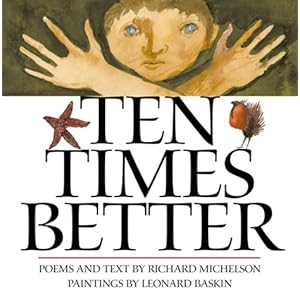 Fun, but as my seven year old daughter said "I know my tens times tables," and I think that would be most folks' assessment of the book. But...
...if you read all the way to the end into the section just past the poems you will find a gold mine!
Multiplication to me has generally always been about memorization. I've been trying really hard lately to push through my wall of resistance about numbers toward something that approximates actual understanding -- I want my daughter, as well as myself, to understand what multiplication really is.
What I've come to learn is that multiplication can be used in a number of different contexts and that there are some basic models that can help a child experience, visualize and conceptualize the meaning behind the operation. Through some reading and a great post from Let's Play Math on multiplication models I've learned that these models include:
Sets or groupings, which we've done a lot of. Arrays are ubiquitous. But the third concept, measurement, is the one I am least comfortable about. I mean, when I was in third grade I memorized my times tables and that was that. But I had no earthly idea what they were for or even how to use them outside the context of an equation. Working through the back pages of Ten Times Better this morning I finally get it. And, what's even better, my daughter got to pull out the 30' tape measure, run laps in the sun room and do some long jumps all in the name of mathematical inquiry. Here's are the highlights:
The back of the book holds amazing information about the twenty or so animals from the poems in the preceding pages. The ant is TEN TIMES STRONGER than humans. If an ant weighed fifty pounds (the weight of a human child) how many pounds could it lift? My girl counted it up on her fingers and immediately sprang up and ran around the living room trying to lift up all the chairs. I nixed that idea, but it was such an immediate reaction that it sparked the idea that this needed to be an interactive experience.
Nine-banded armadillos are one foot long. They are descended from glyptodons who were TEN TIMES LONGER. I must admit I initially tried to get her to just answer the question using her knowledge of the tens times tables. I mean, they're easy, right? But as this activity proceeded I realized very clearly how memorization of facts does not assure an understanding of either how to apply the operation in context and especially not when size and scale are involved. My kid, at least was not getting it, even with an 'easy' problem of 1x10. So, I said, how about using measuring tape? She ran to retrieve the 30' measuring tape and we found the one foot mark. Then we counted out a total of ten feet. Wow! The glyptodon was not huge, but definitely MUCH bigger than it's modern descendent the armadillo.
Some centipedes have 100 legs, but the garden variety has 30. "With so many legs," the text reads "the centipede really is TEN TIMES FASTER than most insects it catches for food ... If a centipede were as long as a six foot adult is tall, it could run twelve feet in one second. How far could it run in ten seconds?" Well. On this rainy day we couldn't go outside, but we measured the sun room at 24' in length. Five lengths would equal approximately 120'. Could she run it in ten seconds? (It took her only twelve!)
Laughing, we went back to the living room. Did you know that elephants are TEN TIMES HUNGRIER than you and eat as much in one day as you eat in a month? If you eat 40 pounds of food every month how much does an elephant eat daily? I started skip counting by 40 (which is really the same as 4, right?) and she joined in. 400 pounds!?! Wow. That one impressed both of us.
Next, the frog. "Most people can jump as far as they are tall," says the text "but a frog can jump TEN TIMES FARTHER." Before I knew it we had jumped up, taped down a line to jump from, measured the length of the girl and she was off! It's true! She could jump the length of her body, and sometimes a bit longer. Can you imagine TEN times further? From the back of the house to the front of the house. Wow.
A baby giraffe is six feet tall when it is born. The kid jumped up on the couch to measure how tall that was. And it is TEN TIMES HEAVIER than a huge human baby. "If that baby weighs eleven pounds at birth...how much might a small baby giraffe weigh?" By this point, she really had the concept and jumped in to start counting by 11, fast, marking on her fingers...110 pounds! She ran off to the bathroom scale. At the age of seven she's about half the weight of a baby giraffe at birth. Awesome!
The goldfish question is great -- if kept in a small and/or crowded bowl it only gets to be about 2" long. If allowed more room, TEN TIMES LONGER! We pull out the measure tape. Here is 2" let's count that ten times... Again, the numbers are one thing, and 20" isn't that long, but seeing the tape/fish get longer, and longer, and longer is another. A living number line!
Our last one was the giant squid that can be TEN TIMES LONGER than the tallest basketball players are tall. "If a basketball player is seven feet tall, how long would a giant squid be?" 70 feet?!? How long is THAT?! Our measuring tape was only 30' long. Our sun room is 24' long. So that means almost three sun rooms long?? Wow.
Did I mention I really, really love this book? Scale is such an elusive concept for me, and I'm sure for kids too. Ten times bigger, longer, faster and smaller is a large enough amount to make an impact, psychologically speaking, on kids who know intuitively that they are small creatures in an adult-sized world. I read somewhere that intelligence isn't the biggest factor in being 'good' at math -- it's actually personal motivation (and, I would add, personal relevance) that motivates someone to engage in mathematical activity. This book provides motivation in spades. I think that kids from preschool to middle school could all get something out of physically measuring out 'ten times longer/bigger/faster' to figure out the answer instead of just calculating it. Just because you've memorized something does not mean you 'know' it. I am living proof!
p.s. I just found this book. No one paid me for a review. But, if asked I'll say it's TEN TIMES BETTER than any other math book I've read in a long, long time!
Wednesday, January 2, 2013
All-in-One? Using Shapes to Explore Number & Algebra Concepts
I'll start right out by saying that I'm pretty sure this was not the right activity at the right time for my 7.5 year old darling girl, but I did learn a lot about where her mathematical thinking is right now, which is always helpful.
In the last one and a half years my inquiry into elementary math education has kept pace with her math learning. We've discovered so much together and it's been an incredible learning process for both of us. Lately, though, it seems like the big picture concepts have clicked for me but as I try to move forward myself I end up rushing her. The following activity is a case in point, but I still think it has merit for some child, somewhere! Here's how it played out:
Back in November I bought a travel set of attribute blocks. We haven't done much with them yet, but after looking through the little activity booklet that came with it I found an activity that piqued my interest. It had to do with figuring out how many blocks of a certain shape (or combination of shapes) you would need to have to get a total number of sides. It looked vaguely algebraic to me but was presented as a mental math activity. So, I thought I'd create my own version of the activity on paper to make it a little easier to follow and to visually reinforce the differences between shapes.
This is the first worksheet I made. In the first example I labeled the triangle with a 1 (meaning one group of three sides) and she had to figure out how many more hexagons made it add up to a total of 15 sides. The second problem also had one shape already labeled, but in the final two problems I left it to her to figure out how many of both shapes. You can see little pencil marks around the shapes at the bottom where she counted the sides one by one and then made notes for herself.

She was not completely happy with this activity (and was in a bad mood, distracted by whether the word 'futzy' was an insult or not). Grumpy or not I think it really stretched her capacity in a good way, well enough for me to try again. In the second iteration I asked her to write the total number of sides under each shape which I think really helped. It was easier for her this time around. You also might notice that I rephrased the question a little.

Then the holidays interceded with math learning. Over that time, though, I did some thinking about how perhaps this kind of activity could be used to reinforce the concepts of multiples and the commutative property. For example, 4 three-sided shapes (triangles) have the same number of edges as 3 four-sided shapes (squares or rectangles). I also wanted to continue to stretch her idea of what the equal sign means; not necessarily a result, but a relationship -- various expressions of the same idea.
Here is the third activity. In it I intentionally grew the numbers from 6 to 12 to 24 to 48.

This time her strategy right out of the gates was skip counting whole groups of sides to work toward her answer instead of counting individual edges. This means to me that somehow in the last three weeks her brain has begun to 'group' with more facility. I think this because, in the same time period, she has also experienced a huge jump in her reading abilities -- from having to sound out familiar words as if they were new every time to simply looking at a word and knowing what it says. The math concept of 'grouping' and the reading concept of 'chunking' are essentially the same skill -- smaller items grouped into a larger whole. I saw that click into gear today with my daughter as she went to skip counting unbidden.
Anyhow, she moved through this last activity fairly quickly until the last two problems. After it was finally over she proclaimed, "That was hard! I hated it! Forty-eight is such a big number!!"
That proclamation was revealing to me -- at this point in the game she's got facility with multiples of 0,1, 2, 3, 4, 5, 10 and 11. The larger numbers are still a lot of work in terms of multiplication. Being able to decompose a number like 48 was just too much at this moment in time. Ultimately, I think it's a call to put on my own brakes and, instead of trying to rush us forward, really dig into the mysteries of number composition and decomposition. I know numbers are my weak point, so this will be good for me personally as well.
Epilogue: After drafting this post this afternoon and then leaving to let it sit for a while I ran across the multiplication card game called Snap it Up which I found a month or so ago while at Goodwill (read about moreof my thrifted math here!). I decided to give it a try and what do you know? It was fun for both of us! One interesting observation was that when I said 'what's x times y' she'd give me a blank look but when I said 'what are two fives...' or 'how many tens make eighty' she totally got it. I love it when the math stars align for us like this. It happens a lot, actually, but I am grateful each and every time.
In the last one and a half years my inquiry into elementary math education has kept pace with her math learning. We've discovered so much together and it's been an incredible learning process for both of us. Lately, though, it seems like the big picture concepts have clicked for me but as I try to move forward myself I end up rushing her. The following activity is a case in point, but I still think it has merit for some child, somewhere! Here's how it played out:
Back in November I bought a travel set of attribute blocks. We haven't done much with them yet, but after looking through the little activity booklet that came with it I found an activity that piqued my interest. It had to do with figuring out how many blocks of a certain shape (or combination of shapes) you would need to have to get a total number of sides. It looked vaguely algebraic to me but was presented as a mental math activity. So, I thought I'd create my own version of the activity on paper to make it a little easier to follow and to visually reinforce the differences between shapes.
This is the first worksheet I made. In the first example I labeled the triangle with a 1 (meaning one group of three sides) and she had to figure out how many more hexagons made it add up to a total of 15 sides. The second problem also had one shape already labeled, but in the final two problems I left it to her to figure out how many of both shapes. You can see little pencil marks around the shapes at the bottom where she counted the sides one by one and then made notes for herself.

She was not completely happy with this activity (and was in a bad mood, distracted by whether the word 'futzy' was an insult or not). Grumpy or not I think it really stretched her capacity in a good way, well enough for me to try again. In the second iteration I asked her to write the total number of sides under each shape which I think really helped. It was easier for her this time around. You also might notice that I rephrased the question a little.

Then the holidays interceded with math learning. Over that time, though, I did some thinking about how perhaps this kind of activity could be used to reinforce the concepts of multiples and the commutative property. For example, 4 three-sided shapes (triangles) have the same number of edges as 3 four-sided shapes (squares or rectangles). I also wanted to continue to stretch her idea of what the equal sign means; not necessarily a result, but a relationship -- various expressions of the same idea.
Here is the third activity. In it I intentionally grew the numbers from 6 to 12 to 24 to 48.

This time her strategy right out of the gates was skip counting whole groups of sides to work toward her answer instead of counting individual edges. This means to me that somehow in the last three weeks her brain has begun to 'group' with more facility. I think this because, in the same time period, she has also experienced a huge jump in her reading abilities -- from having to sound out familiar words as if they were new every time to simply looking at a word and knowing what it says. The math concept of 'grouping' and the reading concept of 'chunking' are essentially the same skill -- smaller items grouped into a larger whole. I saw that click into gear today with my daughter as she went to skip counting unbidden.
Anyhow, she moved through this last activity fairly quickly until the last two problems. After it was finally over she proclaimed, "That was hard! I hated it! Forty-eight is such a big number!!"
That proclamation was revealing to me -- at this point in the game she's got facility with multiples of 0,1, 2, 3, 4, 5, 10 and 11. The larger numbers are still a lot of work in terms of multiplication. Being able to decompose a number like 48 was just too much at this moment in time. Ultimately, I think it's a call to put on my own brakes and, instead of trying to rush us forward, really dig into the mysteries of number composition and decomposition. I know numbers are my weak point, so this will be good for me personally as well.
Epilogue: After drafting this post this afternoon and then leaving to let it sit for a while I ran across the multiplication card game called Snap it Up which I found a month or so ago while at Goodwill (read about moreof my thrifted math here!). I decided to give it a try and what do you know? It was fun for both of us! One interesting observation was that when I said 'what's x times y' she'd give me a blank look but when I said 'what are two fives...' or 'how many tens make eighty' she totally got it. I love it when the math stars align for us like this. It happens a lot, actually, but I am grateful each and every time.
Tuesday, December 18, 2012
Thrifted Math
Here's something you probably don't know about me -- I've got something of a golden touch when I'm out thrifting. Not always, but I do have a track record that is (to me) quite impressive! See what you think about these highlights from the last year:
A down jacket, perfect fit, perfect color, just needed a wash and it was brand new again; I paid $4 and am on my second season with it still in great condition
A Leap Frog talking globe, like-new, retailing for $350; I paid $4 and the kid learned her continents and is onto countries, plus she makes up her own dances to the 'music of the world' option.
A sturdy elementary microscope with three lenses and swivel eye piece, like-new, retailing for $160; I paid $5 and, although we haven't really used it much, I just know it'll come in handy at some point.
We also get a lot of great science, social studies, history and art resource books at our library's resale bookstore. And, just a week or so ago I found two old math games at Goodwill! The first one is Scan, a "split second matching game" from the 1970's. I found a comparable version it online offered for $50. I got it for $1.99 and we've already had a ton of fun with it!!!

When I saw it on the shelf I immediately recognized it as mathematical in some way. There are four categories on each card: color (square, circle, square, circle), position (four black dots on a 4x4 grid), pattern (different combinations of x's and o's) and shape (various irregular purple polygons!).
Our game didn't come with directions and at first I thought it the point was to match all four categories at once. I even went so far as to try and analyze and sort the cards so that I could understand how it might work. Here's one attempt at sorting by grid pattern:

Ultimately, no pattern emerged and I also determined there were no 4-way matches to be made. I'm not very good with combinatorics but even I can figure out (albeit after a bit of struggle) that you need more than 26 cards to have a match for every possible combination and permutation. (Anyone want to figure it out?! Just kidding.)
I went online and found the directions and was relieved to find that you only have to match one category on the center card to a card on the table to win the round. The box said it was for ages 9 to adult, but I decided to try with my 7.5 year old. Initially I thought maybe I'd have to half-size the deck for the first few games so she'd have a chance to get the hang of it but for some reason I put out the full deck on our first game and, what do you know, she beat the pants off of me!

I found the next game about a week after I found Scan. It is not branded so I can only describe it with this picture:

Well, actually, as I was editing this post I noticed the company name Garlic Press in the bottom left corner. Apparently they're still in business and have other similar two-sided 'self-check' math fact puzzles. Essentially, you piece together this round puzzle by doing your multiplication facts...

...which, incidentally, are not in any particular order around the ring, which is a great feature. When you've placed all the pieces you flip it over to see if you got them right. If you did, you have a picture that makes sense. If you didn't you have a good giggle about the parrot's beak and wing being in the wrong places and try again.

I'm not that big on drilling math facts, but I thought it'd be interesting to try and a nice addition to our other work even at the sky high thrifting price of $4.99. What do you know -- the puzzles are fun! My daughter has only done the 0, 1, 2, 3, 4 and 10 times table puzzles so far but she's motivated to do about one per day. I mean, who wouldn't want to solve your 8 times tables if you got a cute little tiger cub at the end of it?!

You use the same procedure to solve each puzzle, which makes me optimistic that she'll start developing some reasoning strategies around the skip counting she doesn't already know backward and forward -- like 11 times something is similar to 1 times something. Or, if I do the 0, 1, 2, 3, 5 and 10 times first in any puzzle, the rest are not hard to figure out.
The multiplication puzzles might be a little hard to make yourself, but if I knew about Scan and couldn't find the game itself I'd totally make a version myself with my kid or other students! The Scan cards are just four quadrants with a basic concept and pattern rule for each quadrant. Also, you need two copies of each card. to play the game. It's essentially a quick-paced matching game for big kids; I think upper elementary kids might really enjoy the challenge of making their own versions and variations.
A down jacket, perfect fit, perfect color, just needed a wash and it was brand new again; I paid $4 and am on my second season with it still in great condition
A Leap Frog talking globe, like-new, retailing for $350; I paid $4 and the kid learned her continents and is onto countries, plus she makes up her own dances to the 'music of the world' option.
A sturdy elementary microscope with three lenses and swivel eye piece, like-new, retailing for $160; I paid $5 and, although we haven't really used it much, I just know it'll come in handy at some point.
We also get a lot of great science, social studies, history and art resource books at our library's resale bookstore. And, just a week or so ago I found two old math games at Goodwill! The first one is Scan, a "split second matching game" from the 1970's. I found a comparable version it online offered for $50. I got it for $1.99 and we've already had a ton of fun with it!!!

When I saw it on the shelf I immediately recognized it as mathematical in some way. There are four categories on each card: color (square, circle, square, circle), position (four black dots on a 4x4 grid), pattern (different combinations of x's and o's) and shape (various irregular purple polygons!).
Our game didn't come with directions and at first I thought it the point was to match all four categories at once. I even went so far as to try and analyze and sort the cards so that I could understand how it might work. Here's one attempt at sorting by grid pattern:

Ultimately, no pattern emerged and I also determined there were no 4-way matches to be made. I'm not very good with combinatorics but even I can figure out (albeit after a bit of struggle) that you need more than 26 cards to have a match for every possible combination and permutation. (Anyone want to figure it out?! Just kidding.)
I went online and found the directions and was relieved to find that you only have to match one category on the center card to a card on the table to win the round. The box said it was for ages 9 to adult, but I decided to try with my 7.5 year old. Initially I thought maybe I'd have to half-size the deck for the first few games so she'd have a chance to get the hang of it but for some reason I put out the full deck on our first game and, what do you know, she beat the pants off of me!

I found the next game about a week after I found Scan. It is not branded so I can only describe it with this picture:

Well, actually, as I was editing this post I noticed the company name Garlic Press in the bottom left corner. Apparently they're still in business and have other similar two-sided 'self-check' math fact puzzles. Essentially, you piece together this round puzzle by doing your multiplication facts...

...which, incidentally, are not in any particular order around the ring, which is a great feature. When you've placed all the pieces you flip it over to see if you got them right. If you did, you have a picture that makes sense. If you didn't you have a good giggle about the parrot's beak and wing being in the wrong places and try again.

I'm not that big on drilling math facts, but I thought it'd be interesting to try and a nice addition to our other work even at the sky high thrifting price of $4.99. What do you know -- the puzzles are fun! My daughter has only done the 0, 1, 2, 3, 4 and 10 times table puzzles so far but she's motivated to do about one per day. I mean, who wouldn't want to solve your 8 times tables if you got a cute little tiger cub at the end of it?!

You use the same procedure to solve each puzzle, which makes me optimistic that she'll start developing some reasoning strategies around the skip counting she doesn't already know backward and forward -- like 11 times something is similar to 1 times something. Or, if I do the 0, 1, 2, 3, 5 and 10 times first in any puzzle, the rest are not hard to figure out.
The multiplication puzzles might be a little hard to make yourself, but if I knew about Scan and couldn't find the game itself I'd totally make a version myself with my kid or other students! The Scan cards are just four quadrants with a basic concept and pattern rule for each quadrant. Also, you need two copies of each card. to play the game. It's essentially a quick-paced matching game for big kids; I think upper elementary kids might really enjoy the challenge of making their own versions and variations.
Subscribe to:
Posts (Atom)
LinkWithin
