Showing posts with label attributes. Show all posts

Tuesday, August 27, 2013

Categorical Variables in Your Feet

The same question has come up three times in the last three months, from three different sources.  Each time I have had no good answer.  When it happened again last week I knew it was absolutely time to figure this out.  The question, you ask?

"What is the difference between variables and attributes?"

Exibit A: The source of the confusion:


I hate giving answers I don't fully understand.  My answer has generally been: "I think I'm using the word 'variable' in the colloquial sense, you know, things that can change around -- I think that, mathematically, these are really what are called 'pattern attributes'."

You see? Totally unhelpful - to the person who doesn't understand math and to the person who does.

In my defense, up until just yesterday I didn't think the use of the word 'variable' in Math in Your Feet was mathematically accurate because I knew that variables are part of algebra and algebra is about inquiry into growing patterns. We make dance steps (pattern units) in our math/dance work but not growing patterns. When we evaluate sameness, similarity, difference and change we are focused more on the, well, attributes, that comprise each individual beat of a four beat percussive dance pattern.

After last week in Minnesota I knew I needed an answer, and I needed it soon! Luckily there was a meeting on the calendar with Gordon Hamilton and Maria Droujkova. We're working on a book that is currently titled, funny enough, "Variables and more". Luckily, I had warned both of my collaborators that this question was coming down the pike.

Maria's answer? Essentially, attributes and variables are almost interchangeable. There's the kind of variable used when looking at change (algebra) and the kind that is used when analyzing something that is set, or static (which we could call an attribute, if we wanted to) like in geometry (or statistics, apparently).

According to Maria, this class of variable is called a "categorical variable" and it is useful for things "that are not ordered".  I think I'm remembering correctly that ordered means, for example, a thermometer. You can compare differences in temperature - it can be hot or it can be cold or it can be in the middle, but the change is measured in a system that is already set.  With categorical variables there is much more freedom to analyze properties and make up your own categories, for example: Movies I Like, Movies I Hate.  Movies My Cat Likes, Movies My Cat Hates. In each of those four cases Movies have been sorted into different equivalent classes, meaning - every movie in the Movies I Hate category will be the same in some way.

The dance equivalent (ha ha!) would be that as students are building their first 4-beat pattern I often have us analyze, as a whole group, individual 'works in progress'.  We do this by focusing on our attention on one movement category at a time (e.g. identify only the directions in this pattern, or only the foot positions). The process of focusing their attention in this way makes their dancing much clearer and much more precise.
Clarifying direction.
But, as I found out, I was right to think that it is mathematical activity too, just a bit beyond my current elementary understanding of sameness, similarity and difference. When Christopher Danielson and I met after my Minnesota dance workshop last week he posited that perhaps a fundamental characteristic of mathematical activity is when you say exactly what it is you want to pay attention to (decompose), focus only on that attribute and ignore everything else, which is really what we are doing when we build and analyze our dance steps.

The only thing still in my mind is that instead of the activity of sorting these movement variables while they create moving patterns they are instead actively choosing them while they compose/design a dance pattern. It think it is probably a similar thinking process, as in "Hmmm, I don't like jumping on all four beats, what other movement can we use?" In that case, students really are focusing on one attribute/category at a time as they choreograph their steps.

This idea of decomposition and equivalence classes are a new conceptualization of 'sameness' for me, something well beyond the idea of congruence which we also use in our dancing. I've had hunches over the last year about how sameness and attributes are the mathematical ideas at the core of our dance work, and I've still got some thinking to do to integrate this new information about categorical variables but, in the end, I am just thrilled that my hunches been have validated in such a spectacularly specific manner.

Thursday, June 20, 2013

Beyond Linear

I started working with six, seven and eight year olds this week.  Two more weeks to go.  To start things out, the summer program I'm working with requires me to create and ask my new students a few questions which I'll also revisit at our last class.

One is "How can you make rhythm with your feet?" The other, "How can you make a pattern?"  The predictable and unsurprising answer to that one? 

Colors.
Shapes.

And that's it.  That's all they got.

My dream is to move kids beyond one-attribute linear patterns.  You know, "red blue red blue" or "circle square circle square."  I think those are fair places to start, but based on my experience last summer, even when kids get into upper elementary, they still give the same two answers as the 6 year olds. 

It's a wasteland out there. We're literally wasting kids' time on AB patterns when we could be engaging them in some truly exciting, interesting and beautiful mathematical pattern-based play, analysis and reasoning.

On my board after the first three days I have written:

"How many different kinds of patterns can we make?"

So far:

Rhythm patterns, in our feet, in our hands

"Recipe" (algorithm) patterns (and there I've noted the beginning 'recipe' for our Pizza Clogging choreography which we'll extend next week with our own favorite pizza toppings in our feet.  I also read them the fabulous book How to Make an Apple Pie and See the World).

Nature's numbers: The first nine numbers in the Fibonacci sequence including the one that showed up in the apple star I 'magically' discovered.


Also, in the slices of paper pizza we've been designing. More magic and transformation for the primary set. (The more math magic the better, as far as I'm concerned.)

Of course we'll also look into linear patterns too, but before we design pattern units and make our beaded icicles we'll  read The Lost Button (a Frog & Toad story) and investigate the attributes in our bead choices (color, texture, shape, size). 

Because, when you have more than one attribute you get to think deeply about similarities, sameness and differences, another thing I don't think little kids are asked to do often enough.  With more than one attribute you get a chance to evaluate, analyze, think, talk, make, dance, sing, tap and clap mathematics.

I don't have a lot of time with these kids, but I hope that the world gets a little bigger and their eyes open just a little more to the beauty and structure around them.  Because how will  they come to know and love math otherwise?  These are the basics, folks.  Just like 'literacy' is way more than decoding written words, so too is math.  A visual, kinesthetic, aural and expressive mathematical literacy for all elementary students.  That's my dream.

Tuesday, June 4, 2013

New Math Game: Change Your Rule

This post is in two parts: The first part outlines the basic flow and structure of a new game idea which, I think, has the potential to support the conceptualization of math concepts such as combinations, permutations, patterns, variables/attributes and reflection symmetry.  

I know that's a tall order so in the second part of this post I briefly discuss my reasoning, pose a few lingering questions and then ask for feedback.

Part One: Basic Flow of the Game
The idea for this new game started with a picture:

Photo via: http://www.fotomat.es/arte-combinatorio/
I immediately thought how cool it would be to have this kind of mathematical art/visual inspriation in a living or learning environment, something to hang out with that evokes noticing and wondering.  In this case, a real-life shelf with spheres and cubes just begs for interaction, something to play around with and ponder. I want one! In the process of thinking about how to get this kind of installation in my own house, a new game was born.  Here's the basic idea:

Make/build a rule.  Find a way to change it.

These are the game pieces. Set 1 includes two shapes, four colors.  Set 2 includes six shapes and six colors.


Rule Change #1: Make a rule/pattern. Using the same shapes/colors how can you make the next iteration different from the first.  Does order matter?  How many different combinations can you make?


Rule Change #2: Make a rule/pattern. Change one element of each shape to make a new pattern.  For example, orange turns into red, or square turns into circle.  For each new design change only one variable for each piece.  How many times can you change the rule? How many new rules/patterns can you make from your starter rule?  Can you ever get back to the original rule/pattern?


Rule Change #3: Build your pattern then reflect the design. What do you have to do differently when you build the reflected pattern?


But what happens if you only use one color and shape?


How many combinations can you make using three of one shape and one other shape?  Would it change things if each of those circles were different colors?

On another line of questioning, what larger design can you make by building your design line by line using the same shapes/colors in each line?


Part Two: Thoughts and Questions

Even though Part One seems like a lesson flow, it's really meant to be more of a general framework for exploration.  My intent was to provide a little structure, some basic 'rules' and a lot of room for inquiry.

I'm wondering if it really feels like a game, or is more of an activity?  If it's going to feel more game-like, does it need more structure?  A timer? Some 'change your rule' cards?  Or, maybe, some cards that say how many different attributes to use in the pattern?  How many different rules would be enough to create a sense of chance? What other 'change rules' would you include?

Based on trying this out with my own kid this morning, if you were to do this more as an activity/lesson perhaps it would be helpful to have some really easy starter examples, like all one color, or two different colors to get the ball rolling in a positive direction.  I asked my daughter to build a pattern with three pieces but then gave her the 'change rule'.  She didn't really like that and we left it there.  The game pieces and board are still out, though, hanging around.  I'll see if she wanders back over.

Questions I still have include: When combining or creating permutations, how much does the second attribute matter?  For example, this first design (two colors, one shape) looks like it combines in exactly the same way as the second design (two colors, two shapes):


Another one of my goals for this game/activity was to also explore the ideas of attributes/variables in design -- how well do you think it does that?  I intentionally did not use pattern blocks -- only one attribute/thing to change -- and instead made my own (Set 1). What would pull the attribute/variable idea out a little further?

I hope it's clear that I am hoping to dig into the brain trust that is my modest but wonderful readership.  That means you by the way, so please if you have any thoughts about all this, I'd love to hear your ideas.  

Things I would love feedback on: key ideas about combinations/permutations at the elementary level, thoughts about the game structure, ideas for other 'rule changers' to add into the mix, and any other thoughts you may have.  Thank you!!

p.s. If you want to leave a comment but don't see the comment section below, please consider refreshing this post or closing the post altogether and come back.  This template has some bugs. If you don't see a green-lettered header and/or the page menu at the top, then chances are the template did not fully load.  Sorry for the hassle. 

Wednesday, September 5, 2012

Kitty Census Redux

Perhaps you'll remember the kitty census that happened at our house last fall.  I just re-read the post and nearly fell out of my chair.  Not only is it touching and hilarious (at least to me) it was a completely different activity last year than what happened this morning.

Last year the kid was a newish six.  This year she's a newish seven.

Last year it was my idea; that morning, the kid just wanted to take her cats to the vet.  When I suggested we could do both she agreed, but only so she could take care of her kitties.  She had no interest in data whatsoever.

This year it was all her idea.  I ventured a suggestion about how to sort and classify all the cats, but it was clearly her gig and so I backed off.  I would have preferred to sort by material (stuffed, ceramic, plastic, flesh and blood, etc.) and then sort into sub categories from there, but the kid had other plans, as you'll see:


It may look straight forward, but the sorting process was actually quite involved.  I mean, really, what's the difference between a multi-colored cat and a spotted one? How come the otherwise solid grey kitties with the white paws didn't get put in the multi-colored pile?  The point is, she had to figure out what the parameters were to make those groupings; any one of us could come up with multiple variations on the same theme and we'd all be right as long as we were being consistent with the rules.  I'd say that's real math right there.

One more difference: Last year she was always performing, but unselfconsciously.  For this year's census she was intent on presenting her process and results in a formal way, specifically on video.  She's the one who decided what to say.  As always, I am just the faithful assistant who just happens to ask a few clarifying questions from time to time.


Yep, you heard right.  Our cat Lucy and my daughter have been added to the final kitty census tally.  72 cats!  Good thing only two of them need to be fed. 

p.s. I've got a new Facebook page where I'm sharing links to cool math activities I find and some other things I'm doing with math, making, dance and rhythm.  Hope to see you there!

Friday, July 27, 2012

Math By Design: Paper Patterns

Summer programming has given me some room to experiment with ideas that have been brewing over the last year.  Ultimately, I designed three new non-dance making activities that reinforced the Math in Your Feet ideas of creating a pattern unit using multiple categories of attributes.  My favorite by far, especially for its flexibility with a range of ages, is this paper patterns activity.

If you've scrolled down already you'll probably be thinking that it looks a lot like a paper quilt activity.  It is, sort of.  What distinguishes it from other paper quilt activities is that there is no pattern to follow, only some guidelines to direct the design process.  Because there's been a day or two at each site this summer where dancing was just not an option -- too hot, too crazy, too distracted by thoughts of swimming after class, whatever -- this quieter activity has been perfect at reflecting and reinforcing the dance work we've been doing on other days.

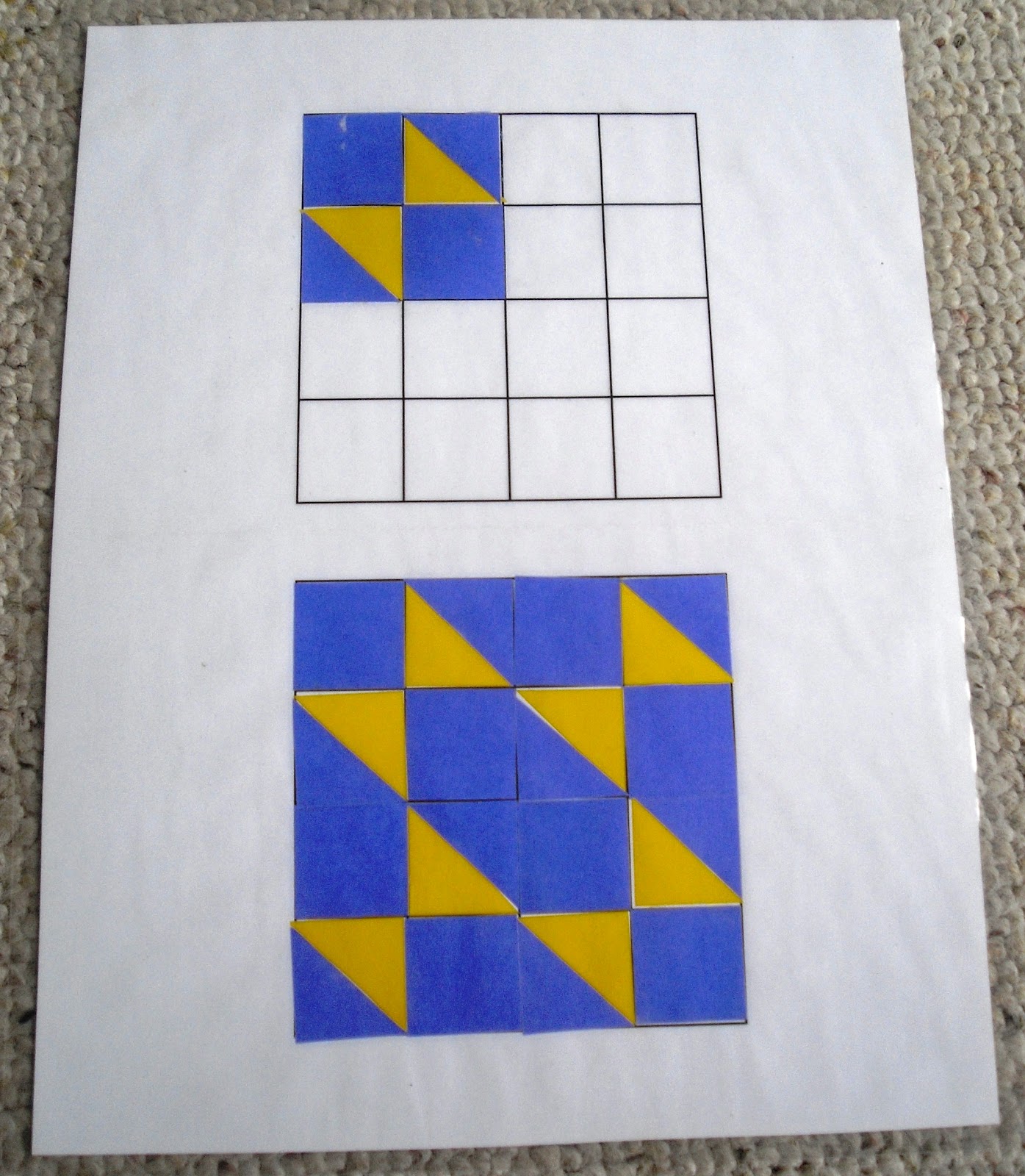
Just as with the dance work, the individually designed paper pattern unit is made up of four pieces (beats in the dance, squares in the paper design) with choices of various attributes.  The pattern unit is then repeated, or joined with a different design, to make a larger pattern, revealing complexity in combination.  Here's how I introduced the activity at my first summer site:


The idea was to experiment with different four-square designs, using a combination of squares and triangles.  At that point the kids would pick their favorite pattern unit and then repeat that favorite four times in the sixteen square grid, as pictured above.

This turned out to be confusing for the kids at the first site.  They were on the younger side (ages seven, eight and nine), most of them emergent or beginning readers.  This, in itself, is a clue as to the importance of an activity like this. A pattern unit is comprised of various smaller parts that make a larger whole.  In math this is called 'chunking' and is a crucial skill for algebra down the line.  If a child has not yet learned to 'chunk' words, they will also most likely benefit mathematically and in their reading from the challenge this activity provides. 

Unfortunately, it was a crazy site, and I didn't have the time or the support to help individual children the way I would have liked.  Since this was the first time I had tried the activity, I didn't anticipate some of the issues that came up.  For example, the kids had too many color choices and ended up using all of them.  It was okay to have four, five or six colors in one, four-square design, but when it was time to repeat the pattern unit, it was much too hard for them to slide the design over or down to repeat it in the grid. 


There was some interesting experimentation with the triangles and squares, though, which is always good in my book.


Do you see what I mean about too many colors (design on the left, specifically)?


Here are two kids who figured it out:


Well...sort of. 


By the time I got to my second site I had adjusted the activity.  I split the sixteen square grid into four smaller, separated parts, and when they had created a design they liked on that sheet I gave them the larger grid. This helped focus kids on the individual unit itself and then make the transition to the larger grid.


The kids at this site were also older (nine, ten, eleven, even twelve).  This time around I decided to limit it to a choice of two colors which I think helped focus the activity tremendously.


This design is a little out of the box, but it doesn't surprise me as this girl was the only one to use a combination of turns in the dance patterns she created.  Her brain was already 'there' if you know what I mean.,


This final picture sums up why I love this activity so much.  Small, simple pattern units get combined to make something surprising, beautiful and mathematically interesting.  The elements of personal choice and action on the design process creates unique results for each child.  Just like in Math in Your Feet.

And the math?  Flips, slides, turns.  An inventory of attributes.  A problem solving process.  Grids.  Patterns. Attending to precision. Just like in Math in Your Feet!

Most importantly, the idea of pattern unit and the concept of chunking is reinforced throughout the entire activity.  And, if they can do it, great!  If they can't, you first and foremost find the beauty in their efforts.  It is this personal work, full of thought and energy, that becomes a self-generated incentive for moving forward to the ultimate goal.  Not only does this activity allow you to celebrate the individual efforts of each child but also makes it easy to immediately assess where the learning points are -- because the evidence is right there in front of you! 

Friday, April 13, 2012

Beading Attributes: Pattern, Color, Shape, Size and...Straws!

My house is a laboratory.  My daughter is the lab rat er, cat.  I'm doing a lot of body-based rhythm and dance this summer with multiple groups of kids ages 6-12 (50-100 a week) but want to balance it out with other representations of pattern, shape and design.  I want whatever we do to have as much choice, challenge, beauty, self-expression and mathematical meaning as possible

I'm trying to figure out how to do all that on a budget.

One of my ideas is a beading project that will work well for both boys and girls in the younger and middle age groups.  I'm thinking about starting with both these books. 

I want the bead patterns to be as simple or complex as the kids require or desire.  I want there to be many possible right answers using a diverse inventory of attributes.  So far that means stiff string, pipe cleaners, spherical wooden beads with multiple colors and sizes, and...straws!!

Yes, I am making my own colorful straw beads.  They're the leftover parts of colorful bendy straws I cut to make this cube: 

 
And these.  


And this!


The older kids, incidentally, will be making at least the tetrahedron and the cube.  If they want to do more I plan to have enough materials on hand for that to happen.  There's a nice balance, a nice ecology, to this me thinks, what with the whole straw being used in different ways over the 6-12 age range.  Here's what I've done to make it work:


Make your first cut at the bottom of the bendy part.  The long part of the straw is about six inches, and perfect for constructing the Platonic solids using pipe cleaners as connectors.  With the remaining portion of the straw I cut the bendy part off (it's the part that expands -- in this case, I'm leaving it unexpanded, but the ridges make a nice texture.)  The top straight part, which is at the top, I've cut into half.  You could leave it longer, if you want, but I liked the shorter pieces better.  That's just me, though.

I experimented with some beautiful plastic pony beads as well but, in the end, there's only one attribute -- color.  The resulting design was really not interesting at all and I think even the youngest kid deserves more than one design element.  The wooden beads are wonderful with so many different sizes and colors and I'll keep my eye out for more sales so they can be a choice for everyone.  The straws are wonderful too because they're less than a penny per straw, offer a different/unusual bead shape, with multiple color choices AND a choice of texture! 

I'm happy with the options so far but will keep searching and experimenting.  What other kinds of (inexpensive but beautiful and varied) beads could I use?  I'd love your ideas!

Saturday, February 25, 2012

Make Your Own Attributes Matching Game!

I have had attributes on the brain for a couple weeks now.  Most of my thinking has been on how the practice of identifying similarities and differences (a closed process) really opens up when put into a design context. 

So, given how much I've been thinking about it, it's no wonder that what I thought would be a ho-hum, pass the afternoon kind of game turned into an incredible brainstorm. 

The kid and I were playing a Blue's Clues matching game.  I was, truth be told, not 100% engaged, but it was a pleasant enough way to pass some time.  At some point I noticed that this particular matching game was really quite tricky.  You'd turn over two cards with green dogs on them but they were different in some very tiny ways. 


Despite some very minor irritation that I might actually have to pay attention, I started to think about what those game designers were doing.  Nothing like a little internal meta-conversation to help put the pieces together....

Click!

Attributes!  On the matching game (brilliant, brilliant, game designers)!  What if we made our own?  Could we make our own?

"Do you wanna make our own matching game?" I asked the kid.  

Needless to say, the answer was yes.  We rushed around the house trying to locate the 3"x5" cards but, of course, they were nowhere to be found.  I rounded up some other paper, the paper cutter, some shapes to trace, and the crayon caddy. 


It was fast and furious, but in the midst of it all we managed to agree on my some parameters:

Geometric shapes only. This is (sneaky) math after all.  We used tangram pieces, pattern blocks, some Cuisenaire rods, and some magnets from the fridge.

Each pair of cards has to be exactly the same.  It's never too early to experience congruence, and what better way to do that then to be personally responsible for it?  This is a key point in my still-developing argument (one that is based on my experience with Math in Your Feet as well as what I've been doing lately) -- it's one thing to observe congruence, it's another to have to be congruent yourself.  I realized as we went along that the 'make a game' energy really motivated my kid to do this part up right. She paid a lot of attention to sameness in her designs.

Each pair of cards have to be different from the other sets in some way.   We have yet to explore this fully, but this means that if you make make more than one set of triangle cards, the sets have to be different from each other in color or design or size.

It's this last point that created the most conversation as we created our cards together.  According to the kid, I was altogether too boring in my designs.  I would say, "But every design you make is colored in!  They have to be different from each other, so I'm going to leave mine uncolored."  This, apparently, motivated her to copy my 'boring' designs and make them 'more interesting' than mine!

So, we had a lot of levels of similar and different going on, including not only what we created but how we were doing it and what our personal design aesthetic was and how these creative choices were different or similar from each other.  My brain hurts just thinking about it!  See what you think:


All told, and in very short order, our prototype set of matching cards totalled fourteen pairs, which made for a very satisfactory game.  I'd love to find a calmer time to for us to work more slowly, carefully, and thoughtfully on another set.  She wants to make sets of matching games to sell at her ever-evolving lemonade-origami-bookmark stand in the spring, which I think might be motivation enough to take a closer look at how to generate similarity and differences. 

If you end up making your own attribute matching game I would SO love to see what you create (please, please, please?!?).

For the Kids Friday

Monday, February 13, 2012

Symmetry Artist: Exploring Attributes Through Design

I recently discovered how important the practice of identifying and describing attributes really is to math learning, especially at the elementary level.  Learning to discern similarities and differences develops mathematical thinking skills that can be used at all levels and topics within mathematics. 

Despite the thrill of discovering how this kind of thinking is used in my program Math in Your Feet, I was left with lingering questions about the differences between identifying attributes and using attributes in a design process.  I suppose they are two sides of the same coin, but I can't help thinking that being able to choose from an inventory of possibilities is the preferable skill-building activity in the long run.

I tested my theory on myself and my six year old daughter by using the Symmetry Artist at Math is Fun.  Maybe you've seen this before?  Check out all the attributes you can choose from to make your symmetry designs:

You can choose between reflection or rotation symmetry, with six to eight choices in each category.

Your pen has five choices.

Seven thicknesses.

And many, many colors.

There's a lot to choose from here, but the tool is easy to use, so you can easily change your mind and start over, or take out your last move or series of moves. 

While you experiment and play around you are also noticing relationships between the lines and shapes you make and observing the structure of the final design.  The addition of color serves to increase the complexity and interest in both the process and the product.

I suppose the difference between identifying attributes and using attributes is that one is a more closed process than the other.  I'm thinking that with a set of attribute blocks, for example, although you are learning to discern differences and similarities, there are really only right and wrong answers.  The benefit of this kind of activity is that you are actively using math vocabulary: thick/thin, large/small, circle, square, triangle, edges, etc.  This is all very useful but, as I said, a somewhat closed process in terms of inquiry.

In contrast to 'compare/contrast/identify' there's the process like the one you use in Symmetry Artist. Instead of simply identifying attributes, you are using this skill in context while thinking mathematically in an active way -- you are actually 'doing' mathematics.  By this I mean you are asking questions ("What would happen if I started my circle here?  What would the same design look like with nine iterations instead of four?  How'd that pentagon get there?"), experimenting with and analyzing your 'answers' (designs), erasing your answers, starting over, printing out the answers you like, asking more questions.... This is the creative process in action; it is also mathematics in action.

I love Symmetry Artist because it is a beautiful and fun way to play around with, learn about, and compare how lines, shapes, and iterations interact within these two symmetries.  Below I've put just a few of the designs my daughter and I recently made. 

As a first grader, my kid uses this tool primarily for exploration.  I started by explaining the different categories, but not much more, and she jumped in from there.  I, on the other hand, being aware of just how many choices I had, jumped in but soon got overwhelmed with too many questions which led to too much erasing and/or starting over, resulting in pretty much nothing to show for my efforts!  That didn't stop me from noticing a few things, however.  Take a look at what we did, see what you think and then go try it yourself! 

Here's my daughter's first design.  Notice that she set it for rotation, 'eight', pen, one color, and a medium thickness.  She 'drew' with abandon, and I was thrilled with what resulted, mostly because I would have never thought to do it that way!  As you'll soon see, my initial approach was a bit more measured.


Her second design was inspired by the first.  "I want to draw a sun!" she said.  I don't know if you can see it, but she started with 'four' red, then 'nine' red, then 'nine' yellow.

Here's the one I made as an example to show the kid what you can do with the tool.  I used 'five', circle, and some variations in thickness and color.  I love the almost-pentagon in the center where the five big circles cross.

The one thing during my experimentation that really thrilled me was that I noticed a difference between the process of drawing a design with a line of symmetry compared with what happened while using 'two' rotation.  Can you see it?

I know what it looks like, and how to describe it, when a two-person team transforms their percussive patterns using both kinds of symmetries, but there was something about using Symmetry Artist that made it stand out to me in a different way.  You are actually drawing one design and the multiples show up automatically.  There was something about seeing it happen in real time (moving patterns!) that I would not have noticed if I had been drawing it by hand, one reflection or rotation iteration at a time.  If I had been doing it that way (pencil and paper) I probably would have noticed something else altogether.

This is all just more evidence that you really do need multiple opportunities to observe and work with a math concept in a number of different situations to really understand it.  In the end, I think that both the act of identifying attributes and and the act of using attributes in a design process (choreography, visual art, tangrams, etc.) have something to offer each other. 

Because I am a teaching artist, dancer and musician, I am coming at math education from a different direction than many.  I am also a big picture learner, so putting math in context makes a great deal of sense to me.  What I am still thinking about are things like: When is it important to just teach math as math?  When do you move on to reflection on and representation of the math you've discovered during an open-ended exploration?  These are the questions that quite literally keep me up at night, and one reason that it's taken me so long to get this post the way I wanted it.  I suppose I may be overthinking things, but I really am curious about all this.

What's your experience with attributes?  I'd love to hear what you think about all this!

Monday, February 6, 2012

A Big Discovery

The kid and I were playing around with tangrams the other day and -- all of a sudden -- I had an Aha! moment.  It was a chain of connected thoughts and realizations which provided clarity around an answer I've been hunting down for the last fifteen months.  Yeah, I know, this big!  Here's how played out:

I recently read a post by Shelisa at Think Magnet which I found at the Love2Learn2Day Math Monday Blog Hop.  The post was about a brilliant game Shelisa plays with her kids every time the family sits down to a meal. 

I was completely impressed with the game because not only did it grow out of a spontaneous observation by one of her kids (my favorite kind of learning) but she was then inspired and able to turn the moment into a wonderfully complex and endlessly interesting activity.

I can't really do justice describing the game here; you'll have to go see for yourself and you'll be glad you did!  But, the upshot is that the game is all about attributes and learning how to discern differences and similarities.  It is also about just how inspiring a playful approach to learning can really be. 

For the most part, I've been following my own kid's interest and questioning related to math over the last six months, an inquiry which has focused on measurement, maps, number patterns, and geometry discoveries.  Reading Shelisa's post I started wondering how I might incorporate it more directly into our own math explorations.

So there I was, later that day, mulling all this over at a semi-conscious level in the back of my brain while sitting on the kitchen floor with my daughter.  We had just re-discovered a whole box of tangrams, with four or five puzzles all mixed together. 

"Look Mama!" the kid exclaimed, "I made a parallelogram out of triangles!  And I can use two more triangles to make it into a rectangle!" 

At the time I was playing around with building squares and I decided to start building onto her rectangle.

"Oh, look!" I said, "I can make a big square out of two triangles.  And I can make a second square out of four smaller squares.  If we make a third square and add it on, we'll have made your rectangle even larger!  How can we make the third square differently from the first two?"

And, in my mind, I said: We can play around with position, size and color.  Adding attributes like these increases complexity and interest...

And that's when it hit me.  How many ways can you make...?  That's the question I had been asking the kid about the number twenty or the number ten.  And here I was asking a similar question (How can you make the third square different from the first two?) about combinations of shapes, and colors, and sizes. 

Attributes and combinations. 

I ask this type of question in Math in Your Feet too: Which of these movement variables will you choose as you create your four beat pattern?  How can you make your second pattern different from your first?  To help them find their 'answer', students use a tool I created called Jump Patterns to choreograph their own foot-based percussive dance patterns.  Jump Patterns are created by working with the elements of a percussive dance step (the related math term being 'pattern unit').  Take a look at the chart I use in the classroom:


Students use this chart to experiment with what I have always called Movement Variables, except now I realize that, in the math sense, they're a collection of....attributes!

For the classic set of attribute blocks it's five shapes, three colors, two thicknesses and two sizes.

In Math in Your Feet kids choose from five foot positions, six types of movement, and six directions to create each of the four beats in their Pattern A, and then they make choices again when they choreograph Pattern B.  There are two other categories to work with as well, including tempo and starting position. 

Here's why it's a big deal:

The math topics in Math in Your Feet have always been clear to me: concrete, kinesthetic experience with spatial reasoning, combinations, congruence, transformation, reflection, and rotation.  These are the things kids and their teachers know are being taught.  They've always been the 'selling points' of the program because they are easily recognized and understood as 'math'.  

But, after years of  working out connections between these topics and percussive dance I knew there was more going on than simply learning 'about' math.  My hunch was that there was some real mathematical thinking going on, I just needed to figure out where it was occurring and how to explain it.

This hunch was one reason I embarked on my current math quest (chronicled in this blog over the last fifteen months).  I've been working hard to figure out what it means to 'do' math.  And now, my new understanding about the nature and purpose of identifying attributes in elementary math education has provided at least part of the answer:

When children are able to identify the elements (attributes) that they have used in their creative dance work they are thinking mathematically.  When they use this understanding to analyze and critique others' creative work they are thinking mathematically.  Attributes are 'charactaristics of an object or a shape' and I'm confident that this definition is broad enough to include moving pattern units as well.

I am struggling at the moment to articulate my thoughts about the differences between identifying attributes in a traditional math education setting vs. choosing attributes in a creative or design process.  But, no worries!  After more than a year of asking, surfing, conversing, reading and learning, I feel like I have won some kind of prize!  And, thanks so much to everyone who is sharing this journey with me.

p.s. If you want to learn more about Jump Patterns, here's a link to an article I wrote that details the whole story of what they are, how I developed the tool, and how they are used in the classroom.

LinkWithin

Related Posts Plugin for WordPress, Blogger...