Showing posts with label math and dance. Show all posts

Tuesday, April 29, 2014

Math, Dance & the Shoehorn, Together Again

First off, what's the difference between this:


and this?


Which one provides the more meaningful learning experience with multiplication? 

I mean, just look how many ways we can experience and come to understand multiplication! Stunning. Given this reality, why would we want our students to only understand multiplication as a series of facts?

So, now, take a look and tell me the difference between this (done as part of a computer science education project):


And this (start around 0:25 and watch until at least 2:00):


Which one provides you the more meaningful experience with Hungarian folk dance traditions?  

Can you see what happens when the dancing's sole purpose is to be shoehorned into a formal mathematical framework (the sorting algorithms)? 

To me, Video #1 has some interesting footwork but the choreography seems stilted and out of context -- sort of like only ever memorizing multiplication facts.

This may just be my own particular sensitivity but I'm curious what you think. Bonus points for going to the dance/computer science project website, trying out one of the sorts and reporting back how or if the dancing helped you any more than the computer animation they provide.

Wednesday, April 9, 2014

Emerging Voices [Residency Notes Day #2]


This is the day kids really start dancing.


After spending all of day one in various stages of disequilibrium, day two brings an integration of new skills.  If day one was about "Oh my gosh, look what we get to do!" day two is about "Oh my gosh, look what I can do now!" and "Look what we can make!" 

Note #1: Clarifying intent (paying attention to the attributes of moving patterns)

This is also the day we focus on sameness. As in, how can we make our dancing the same as our partner's dancing?  What exactly needs to be the same?

Type of Movement
Me, to different teams of students working on their four-beat Pattern A: "Is that a jump or a slide?"

Choice of Direction
Me, during our periodic active observations of work in progress: "Are they turning the same direction or opposite directions?  How can you tell?"

Foot Position
Me, to dancers: "Are your feet split to the sides or is that a diagonal split?" or "How does it feel to finish with your feet crossed?"

Note #2: Experiment<==>Create

Today I spend a lot of time roving around the room just observing. At the beginning of creating their four-beat Pattern A, their feet and physical intention still emerging. They have to organize and integrate the ideas they see in their heads and communicate it with their bodies.  They also have to sync up with their partner's dancing as well.  This is a fantastic, engrossing challenge. It is also fascinating to watch their dancing/moving/body voices emerging so spectacularly over the course of the hour.

As the class proceeds, they all want to show me what they've come up with. We talk. When I show up near them again, the pattern looks different than I remember. "Oh, you changed it!" I exclaim. "Yeah, we like it better this way," they grin, proud of their agency and resourcefulness. Their dancing is cleaner now too.


Note #3: Thinking bodies
(observing the research on gestural thinking, literally in action)

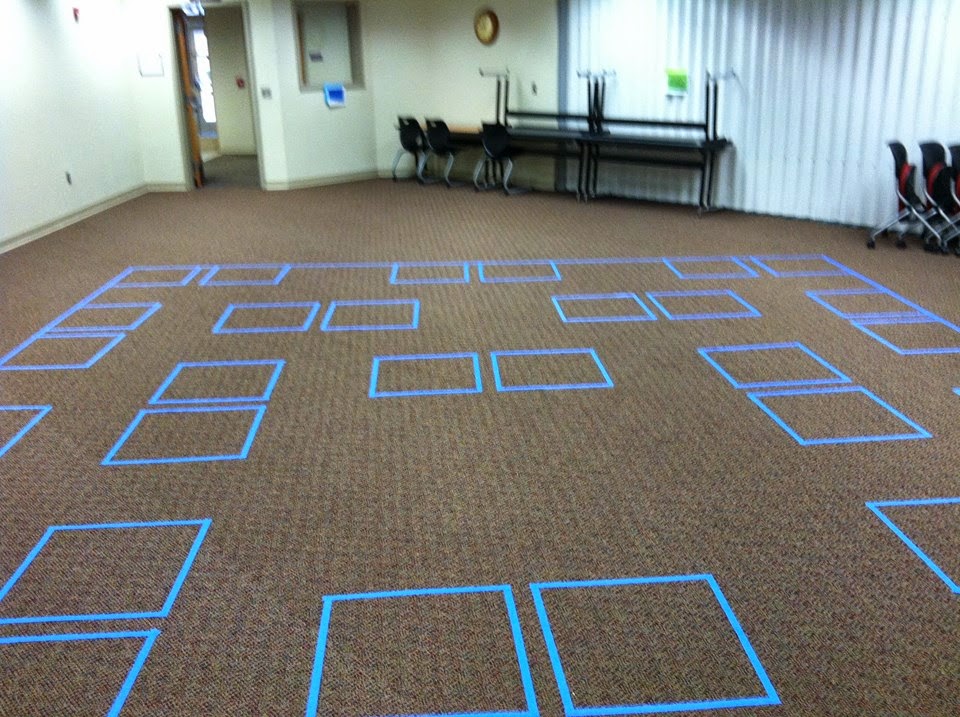
Teammates discuss the similarities, sameness and differences of their (blue, taped, square) dance spaces.  In one class, children noticed: "They both have four corners" and "They have four parallel lines." 

Me: "Are there really four parallel lines?"  Discussion ensues.  At one point, a boy lifts his hands and, without speaking, uses his fingers to trace two parallel lines vertically in the air, and then two parallel lines horizontally.

Me: "Good! So by that I think you mean there are two sets of parallel lines?" He nods. I say, "Okay, let's all trace those lines in the air..."

Note #4: Thinking bodies (hive mind)


Wayne McGregor is a dancer and choreographer who engages in multi-disciplinary collaborative research around how the body thinks and learns, both the individual body, and the larger thinking whole created by a larger social systems. In his 2012 TED GLOBAL talk he provides a helpful primer of what it means to think with one’s body, especially within a dance system:

“So for me, choreography is very much a process of physical thinking. It's very much in mind, as well as in body, and it's a collaborative process. It's something that I have to do with other people. You know, it's a distributed cognitive process in a way …

The work we do in teams of two to choreograph math-informed, math-infused percussive dance patterns is social learning.  Not only do ideas flow verbally and physically between student teams, but also within each class; the energy in the room while kids are making often resembles a beehive. Today, for example, about half way through my most challenging class, something clicked and everyone was working intently; I could literally feel the group working and thinking together on their individual projects. 

[Residency Notes Day #1]

Monday, April 7, 2014

Squaring the Septagon [Residency Notes Day #1]

Note #1: Squaring the Septagon

First, let me just say that I almost met my match in terms of spatial problem solving today.  Almost, but not quite. 

I arrived at the elementary school this morning where I'll be working in the LGI room for the next two weeks with some awesome 4th graders and their teachers.

The LGI room is an extremely irregular septagonal shape, with a long diagonal and without any linear referents on the floor (no patterned carpet or tiles). Add to that our taped dance spaces are square.  It was my job to square the space.

I'll let that sink in. 

Given the difficulty of the task, I think I did a pretty good job.  What do you think?


Note #2: Why do we use so much tape in Math in Your Feet?

Because we do better, more interesting work inside our own dance spaces. Because it helps us focus on the relevant structure and shape of our dancing. Because dancing in limited space is part of many traditional percussive dance styles. That's why!


Note #3: What do I look for on the first day with a new group of students?

Can they keep a steady beat?

Do they know their lefts from their rights?

After a few rounds of our 4-count patterns during warm-ups do they get that we are dancing for four beats, and resting for four beats (signified by claps)?  Do they get the essential structure of the pattern unit and stop their movement on beat 4 or do they keep dancing?

Are their bodies organized? What challenges do they have lifting their feet off the ground? Do they loose track of their personal space and bump into their neighbors or end up far away from the rest of the group? Is it just a few kids, or the whole class?

When I give them words to say while they are dancing (e.g. "Split, cross, split, together") can they talk and dance at the same time? Or does the talking throw them off?

How much new information can I give them before their attention drifts? (Some groups enjoy more words and information, others get overwhelmed with too much input at one time. This tells me how to structure future lessons. The classes that zone out with too much talking need shorter bursts of the dance/talk cycle.)


Despite differences between individual kids and even whole classes, experience has shown that marking this starting spot can help us celebrate success as defined by amount of forward movement and improvement at the end.  Here's more on that:

Tuesday, February 4, 2014

Spring & Summer Fun: Updated Teacher Professional Learning Workshops


If you are interested in the intersection of arts, math and learning you will want to try and make it to one of the following teacher workshops, for sure.  If my itinerary this spring and summer ends up not including your geographic location, then let's do something about that! Feel free to get in touch any time to talk about how to make a Math in Your Feet or Math by Design teacher workshop happen in your area.

Here's what's set so far:

Thursday, April 10, 2014
4:00pm to 7:00pm, Clowes Memorial Hall, Butler University, Indianapolis, IN
Three hours of dig-in, hands-on experience with the the core Math in Your Feet lessons. $30 workshop fee. Participants leave with a comprehensive workshop packet, a link to the classroom materials packet, and new understanding of how you can make math and dance at the same time. More info on the workshop can be found here.

June 16-18, 2014
Richland Institute for Professional Learning, Union College, KY. 
Three full days of hands-on learning integrating math and the arts! Four teaching artists will provide a range of math/art combinations for use in the classroom.  I will be providing a comprehensive program that includes three hours of teacher workshops with an additional three hours of work with kids. After your workshop with me, you then get a chance to observe and assist me in the student workshops so you can see how it all plays out with real live kids. There are three separate tracks for primary, intermediate, and middle/high school teachers and a number of artistic mediums represented.  Awesome.

July 24-27, 2014
Twitter Math Camp, Tulsa, OK.
Embodied Mathematics: Tools, Manipulatives, and Meaningful Movement in Math Class,
2-hour sessions over three mornings, Co-presenting with Christopher Danielson, and make sure to read his post on our session!

This workshop is for anyone who uses, or is considering using, physical objects in math instruction at any grade level.  This three-part session asks participants to actively engage with the following questions:
  1. What role(s) do manipulatives play in learning mathematics?
  2. What role does the body play in learning mathematics?
  3. What does it mean to use manipulatives in a meaningful way? and
  4. “How can we tell whether we are doing so?”
In the first session, we will pose these questions and brainstorm some initial answers as a way to frame the work ahead. Participants will then experience a ‘disruption of scale’ moving away from the more familiar activity of small hand-based tasks and toward the use of the whole body in math learning.  At the base of this inquiry are the core lessons of the Math in Your Feet program.
In the second and third sessions, participants will engage with more familiar tasks using traditional math manipulatives. Each task will be chosen to highlight useful similarities and contrasts with the Math in Your Feet work, and to raise important questions about the assumptions we hold when we do “hands on” work in math classes.

The products of these sessions will be a more mindful approach to selecting manipulatives, a new appreciation for the body’s role in math learning, clearer shared language regarding “hands-on” inquiry for use in our professional relationships and activities, and public displays to engage other TMC attendees in the conversation.

Don't all these workshops sound fascinating and fun?!  Please come and learn with us, and if you can't, let's find a way for me to come to your area!  You can get in touch via www.malkerosenfeld.com.

Monday, October 14, 2013

Meaningful Non-Dance Movement in Math Learning

My conversations with Christopher Danielson over the last couple months about dance, math, Papert and learning have inspired me no end.  He's a great provoker, and I say that with the utmost respect, especially in the area of question asking.

One big question he had for me has gone unanswered for what seems like months, even though it's been just over a week. I've been thinking intently about other related topics but his question has been in the back of my mind the whole time. Christopher asked:

"Do you have examples of meaningful movement in mathematics teaching that are not dance?"

The answer may take many lifetimes of work, but we can still benefit from partial answers and that is what I provide here.

To start, meaningful movement in mathematics learning can be either dance or non-dance.  Dance implies a meaningful system in itself -- in my work, for example, percussive dance steps can be created using a variety of movement variables authentic to the art form coupled with a musical aesthetic.

Examples of non-dance movement in mathematics learning has been a little harder for me to nail down.  This is what I have so far, please feel free to add to this list.

1. Meaningful non-dance movement in math learning happens in the natural body system of gesture and everyday movements (as shown in the work of Susan Gerofsky and this study that showed that 'children think and learn [math] through their bodies. Also, here's a past blog post of mine with links to more research and thinking on this topic).

This body system of gesturing as both a way of expressing knowledge and a way to think through ideas (mathematical ones, specifically) is at work whether we have noticed it or not.  As with anything related to body knowledge, we need to grow our movement/math learning eyes so we know what to look for in our learners.  A recent post on Christopher's Talking Math with Your Kids blog shares a story of a child using her own body knowledge to essentially discover one-to-one correspondence.  This is not necessarily gesture, but it is a potent example of something we could notice in this realm.

The idea of gestures as non-verbal expression and thinking makes sense to me. On the whole, we tend to consider real knowing/learning as verbal and symbolic output.  All I can say is that this hyper-focus on educating ourselves "from the neck up" coupled with the disappearance of hands-on learning-by-making in school (shop class, art, music, etc.) has alienated generations of children and convinced them to think they are really not all that smart when in fact that is not the truth at all. I was one of them.

2.  Meaningful non-dance movement happens in a system where the child is using previous experiences in her body, or creating new understanding through her body, during exploration of mathematical ideas and concepts in school or with adults...and has agency over the exploration.   

What does this mean?  Seymour Papert's LOGO turtle geometry as described in his book Mindstorms is a great example. Papert coined the phrase 'body syntonic' to describe this kind of body knowledge -- "ideas which are compatible with one's own feelings of being in a body." [source]

But, as I've stated recently, just because you have a body does NOT mean you will automatically be able to develop ideas from it or access it in learning.  Papert was presenting a way of learning that still, for the most part, has not been fully understood in formal educational settings.  Essentially, the work Papert was doing with his turtle was to create a learning environment that provided enough structure for children to learn mathematics on their own. [Take a minute to let that sink in...]

This is agency -- the freedom to lead your own exploration and make mistakes on the path to new understanding.  When a child is thinking about the choices she wants to make with the Turtle, it is her own body knowledge she relies on.  That's agency. What is not agency is setting up that turtle and giving a class the exact same step-by-step directions on how to make it draw a flower, or a house, or whatever.

Where else can a child build and call on body knowledge in a setting that allows learner agency?  I just got home from the FroebelUSA conference where we got to experience most of the ten Froebel Gifts. Friederick Froebel was the guy who invented kindergarten over 200 years ago. If you have blocks and math manipulatives in your classroom or home, then you are experiencing Froebel's legacy.  If you know of Waldorf and Montessori, then you know a little bit about Froebel because they are shoots from the root of his system.  If you are familiar with the names and work of Buckminster Fuller, Kadinsky, Frank Lloyd Wright or the Bauhaus, then you know of people who attended Froebelian kindergartens (ages 3 through 7 but extendible to any age.)

Froebel's gifts are essentially what Papert might call 'objects to think with' -- starting with a wooden sphere that can fit in the palm of your hand, on to a solid cube, and then various interesting divisions of the cube, and other gifts to explore surface, point and line.  Here's a picture of Gifts 3 and 4:


In the Froebel system there are three main ways to experience the gifts: using a narrative context in which to explore the properties and powers of the materials, explore the mathematical properties of the materials, and as a 'form of beauty' including exploration of symmetry and patterning.  Sometimes the gifts are presented in a guided way, but it seems that there is plenty of opportunity in the Froebel system to explore these materials freely, with personal agency.

My main point:  

As Professor Eugene Galanter (one of the founders of cognitive psychology) said during his keynote at the start of the FroebelUSA conference:

"The mind needs a body to work in."

As I write this I am finding all sorts new questions in these ideas I've set out and it's clear that this topic requires much more than a single blog post.  I've written more in depth about the differences between dance/math exercises (low to no agency), lessons (potential for limited agency) and truly exploring and making mathematical meaning through dance making (high agency) in the Math in Your Feet program.  You can read and download the newly published article here.

Let's keep this going: Am I missing anything?  Any holes in my argument? What other examples of meaningful non-dance movement learning can you think of?

Addendum, October 15, 2013: Here are some more specific examples of a child (my own) learning math through her body. "Thinking Like a Straight Line": Examples of a Body Learning Math

Thursday, October 10, 2013

Challenging a Literal Approach: Learning Fractions 'through' Music

The last week or so I’ve been thinking quite a bit about what makes real connections between math and dance in a learning setting.  I’ve come to the conclusion that none of those connections can even be attempted without first looking at our assumptions about what math is and what dance is. 

I’ve been sharing my thinking on this blog, to an audience which (I assume) is more familiar with math learning than with arts learning and over at ALT/space, an online writing project I edit and curate for the Teaching Artist Journal.  I’ve not had a huge amount of responses, but the quality of the feedback I have received has been incredibly helpful in moving me forward on this line of inquiry.

Most recently I had a great conversation with friend and colleague Nick Jaffe.  Nick is, among many things, an incredible musician, teacher, thinker, writer and editor.  He’s not a math educator, but he’s definitely not math averse. 

We were talking about how people often try to teach fractions by connecting it to musical notation, which I have always seen as a very literal approach to what people perceive as music (written notation).  Over the course of the conversation I finally understood why I had always viewed that as a very shallow, un-meaningful activity.  Specifically, Nick has a lot of interesting and helpful things to say about discrete and relative quantities when playing music so I thought I’d share our discussion here in case it is helpful to you in any way.
………………………………… 

Me:  I have seen very little evidence that making the correlation between fractions and music have had had any impact. Maybe one study, but they didn't let the kids actually play around with ideas or make their own music -- they just taught them how to play the fractions. And, seriously, do you think like that when you're *playing* music? 

Nick: When people ask me about music and fractions, the first thing we need to establish is that the analogy between musical notation (or the musical reality it describes) is multi-dimensional. Notation denotes both the note as a discrete duration, but also as a division of a larger whole. Which, as I understand it, is also in the dual nature of fractions and an important thing to grasp, and not entirely intuitive.

What seems essential, at least in elementary and middle school math, to understand about fractions is that they have a dual function mathematically--they are a way of signifying two things at once: a discrete quantity, and a relative one. Musical notation functions the same way rhythmically.  In both the abstract, mathematical context, and in the context of music, the same problems arise with regard to this dual nature.  And it is somewhat counterintuitive to students at first to consider this--it's never explained clearly but it's the crux of everything one does with fractions as far as I can see.

I like the question you raise about how one thinks when making music. I think the answer is yes and no. Let's leave aside conscious methods of fractional or theoretically driven music making. Let's consider improvisation which would seem to be the most spontaneous, least theoretical approach to music making. And let's just stick to fractions as a rhythmic concept for this particular argument.

When I improvise I do not consciously think about the duality of a note as a time duration (discreet and part of a larger repeating whole). However I absolutely have to manipulate time, consciously and/or unconsciously as both things.

I think that duality is at the heart of choices about phrasing, for instance. You have to feel a note as a discreet duration, an almost word-like gesture. But you also have to feel it in relation to a pulse, even if there is no pulse, or you are trying to erase any implied pulse--it's still in reference. One does not have to consciously think in terms of fractions to do any of that. However, learning to read notation, and practicing manipulating that duality (playing behind, on, or in front of the beat for instance) can often increase one's control over it.

Finally, analyzing, generalizing and theorizing about that same duality can open up new options, or allow the translation of one dynamic application (actual playing) from one musical context to another.  In that sense theory is both a stimulus to new ideas and means of translating an idea for different contexts. I think theory plays those roles in most disciplines--a generalization that makes possible the prediction of as yet unknown dynamics. 

Me: The problem with using music notation to teach fractions is precisely what you just explained.  The written notation is the quantity, and the actual musicality/music playing is the quality.  What people don't get about mathematics is that 1) it’s not just about the notation (same for music) and 2) it's really about the quality of the quantities.  If you focus just on "how much" you get a dead language or, at the very least, information devoid of meaning. Which is why so many people hate math – for many reasons, and I’m speaking very generally, math education has essentially been bleached of its meaning.  

Nick: I’m actually not that interested in the idea of using musical notation to teach fractions. That seems boring and highly inefficient. What I am interested in, and I think kids might be as well, is working with music and fractional ideas at the same time to make interesting things. Perhaps those things would be musical, perhaps mathematical, perhaps visual, perhaps both.   Undoubtedly one would learn various things in doing such work, but I think it is the making that is what is appealing to me (and perhaps students) and that any real insights and learning depend on the impulse to explore in order to make. 
…………………
 To sum things up, Nick’s thinking about the nature of a mathematical idea (in this case fractions) in relation to his art form is exactly the kind of thinking process I engaged in to find a meaningful overlap between math and percussive dance in Math in Your Feet. It is also a perfect example of how it is possible to teach parts of math starting with your own experiences inside another discipline.  

Where to go next? One of the best music, math and movement resources I’ve run across is from Ellen Booth Church. The activities described in this article describe perfectly how the core concepts of mathematical activity can be connected to musical and movement activity.  Ellen is an early childhood specialist, so her ideas are based on that age group and applicable up to about grade 2, but I think this is the perfect starting place for anyone interested in making these kinds of connections in their own classrooms. 

Monday, October 7, 2013

IF

I've been thinking intently for the past week. I've finally come to the conclusion that the challenge we face when bringing dance or movement into the picture during math time is not necessarily related to creating meaningful and effective learning experiences for our students, although these are certainly important concerns.

No, the issues we collectively need to address, before we can even start that process, are our deeply held beliefs about what math is and what dance is.

If math learning means number facts, right or wrong answers, learning algorithms, memorizing procedures, and experiencing math topics in isolation from one another then this video makes perfect sense to me. (I love the energy here, but question the assumptions.)


Or, this -- a very strong example of non-dance movement but, again, with the ultimate goal being memorization of math facts.


If, on the other hand, we can come to not only accept but truly understand the following vision of math making and math learning:
"Mathematics is a highly creative activity.  Mathematicians solve problems, but they also pose problems. They inquire. They explore relations. Investigate interesting patterns and craft proofs.  They present their ideas to the mathematics community and those ideas hold up only when the logic of those arguments are accepted. They don’t have a wise one who they line up for to check their answers with a red pen." - Cathy Twomey Fosnot (excerpted from this Context for Learning video)
...and if we can at least consider, as I argued recently, that the body is more than a drawing tool...

...maybe then we could come to accept (and eventually understand) how body knowledge is different from but not inferior to what we see as 'real learning': verbal and written discourse and reasoning abstractly through the medium of notated language.  If we could do this then perhaps eventually we could create some clarity on how the body can be more than simply the handmaiden to the goals of other disciplines, specifically math, in educational settings.

I'm still thinking on all of this, and it's for sure a good kind of think, but I do wonder sometimes if I'm setting the bar too high. I'll leave you with what I know:

- Kids love to move.

- Kids love to move, but there are different kinds of moving and different kinds of learning-while-moving.

- In her book, Smart Moves: Why Learning is Not All in Your Head, Carla Hannaford said, "Learning, thought, creativity, and intelligence are not processes of the brain alone, but of the whole body."

- There are ways to bring dance and movement into math learning and still maintain the integrity of both disciplines. My recent article in the Teaching Artist Journal goes into further detail about how this can come to be.

Wednesday, October 2, 2013

Starting the Conversation: Meaningful Movement and Math Learning

I had an interesting conversation on Twitter today with Christopher Danielson about body knowledge (Papert) in relation to mathematical knowing and learning. I've Storified it now but here's what showed up in my in box later in the day -- perfect timing, as they say.

Some thoughts before you watch:

1. This is the first dance/math video I've seen that I've not been grumpy after watching it. I think I also finally understood statistics. That being said...

2. Could these concepts be illustrated effectively in some other way, meaning without the moving human bodies?

3. What, if anything, have we learned about dance in the process of watching this video?

4. What, if anything, could be learned by turning this into a dance lesson?  Would we understand anything more or differently after creating a dance based on the ideas in this choreography?

5. Would the dancing make sense without the text on the screen before and after the dancing?  Would the math in the dancing make sense without the text?


If we are serious about using movement, or a specific dance form, in our math classrooms, I think it's worth thinking and talking about these kinds of questions. I'm not sure I have good answers for all of them, and I will weigh in, but I'm curious to hear your perceptions and thoughts first!

Wednesday, September 25, 2013

New Article | Making Math and Making Dance: A Closer Look at Integration


An excerpt from my newly published article for the Teaching Artist Journal:
"In the eight years since I first had the germ of an idea about the possibility of connecting percussive dance and math at the elementary level I have had more questions than answers about the nature of arts integration, specifically in relation to mathematics...
"After some years of sitting on this question, and a few more of actively searching for answers, I think I have finally come to an understanding about what is going on in Math in Your Feet. I am much clearer on how the math and the dance  interact beyond specific math topics and vocabulary.  These are answers about the really interesting, important connections between percussive choreography and mathematical thinking, moving well beyond memorization and procedure and into the real processes of doing math.  They are also answers about the choices I made as I brought my art form and the strange, beautiful world of mathematics together for young learners."
Ostensibly, the audience for this piece includes arts educators and teaching artists but I humbly submit that anyone interested in interdisciplinary teaching or learning, especially in concert with mathematics, may be able to take something of value from this piece. And, the same goes for math educators interested in how to harness what Seymour Papert called 'body knowledge' (in his seminal book Mindstorms) in a way that maintains an authentic learning experience in both math and dance.

You can read the entire article here.  This piece is the result of over two years of investigation, thinking, learning, exploring and question asking. I am curious to hear your thoughts, observations and, hopefully what new questions you might have.  Any feedback you wish to share will be extremely helpful as I begin to conceptualize and outline a much bigger writing project that will considerably expand on the ideas in this new article.

Sunday, May 12, 2013

"Dear Malke..." 4th Graders' Letters of Learning


I had an incredible week of dance making and math making with 160 fourth graders.  Yes, that's five classes of 32 students.  Every day for five days.  And, yes, I was tired, but it was totally worth it.

It was worth it even before I got a packet of incredible letters from one of the classes, but what I found written there showed me just how impactful this week really was. 

For just a little context, this was the ideal Math in Your Feet residency.  The teachers were all on board and supportive during the dance classes, which makes a huge difference in students' learning.  And, they also made time to have the kids work in their residency journals, with special attention to the daily reflection prompts and word studies which also makes a huge difference.  The classes were filled with enthusiasm for making and learning.  By the end of the five days it seemed that almost every student had moved forward in their understanding of and skills in both the dance and math.

There was one class, though, that seemed to struggle more than the rest.  Their attention would wander and, when I talked, they seemed to need lots of time to process my words.   It took me until the final day to feel like I was making a connection with them.  So, it really was success when, on that final day, almost all the students in that class were able to perform their final original 8-beat pattern.  

But when I read the 32 beautifully hand-written letters from the students in this class I knew it  was more than success, I knew it was an out and out victory.  I mean, just listen to their reflections!  They are filled with descriptive details of personally relevant learning and understanding of program topics.

-------------------------------------------

“I really want to thank you for helping us with dance and math.  I really enjoyed when you danced for us it was awesome.  It surprised me when you taught us about reflection.  I would never have thought about you doing that.  I learned that you can make math fun while dancing.”

“I like (sic) all the things you taught us when we were in there, but what I like best was that you were allways (sic) excited with what we had did in our patterns.  I am happy we learnd (sic) this and thank you.”

“Thanks for every day leting (sic) all of our bodies stretch out every day at 9:15…I loved how on the last day you left the tape all mest (sic) up and you said you can do your dance step without the tape.  I’m still kind of confused with how we did A + B together, but it was still fun because you were there to help us.”  [I love this comment about getting to move/stretch.  This came up in verbal reflection in a different class too.]

“I like how you teach everybody you meet that you can learn to clog and learn math at the same time.” [Well, not everyone....] 

“Thank you for coming in and teaching us clogging, patterns and tap dancing.  I learned that a pattern is a rhythm or beat that repeats.  I also learned congruent means all the same.  Also reflection means the same but oppisite (sic) rights and lefts.  I enjoyed and was surprised we got to make and perform our own Pattern A and B.  My partner and I are still struggling to combine and reflect our pattern.  Thank you!” [Kids are often surprised that they can make a dance step.]

“I was surprised because I didn’t know how much fun math and dancing together was.  Thank you for helping me realize that.  I realy (sic) enjoyed Math in Your Feet.” 

“You have taught me and my class so well.  You taught me about movement and direction.  I enjoyed when we got to make our own dance move.” 

“Thank you so much for teaching me about percussive dancing and math.  It helped me on my math test and I got to have fun too.  The best thing about Math in Your Feet was sharing my dance with my classmates.  I had a lot of fun.” [Just for the record, this is the first time a kid has mentioned a test in this kind of reflection.]

“Thank you for the math, dance and patterns. I really learned a lot.  What I learned was that your dance moves has to be all the same.  I also learned how to combine my dance moves together, although it was hard but I got it.  I had a great time with you and I’m pretty sure the rest of the class did to (sic).  [The idea of 'patterns' is introduced and carried on from the very first day.] 

“I really enjoyed the part where you got to find a partner and make up a 4 step dance.  I also enjoyed the warm-ups when we got in the room.  I really enjoyed learning and dancing with you.  You have taught me things I have never knew (sic) about dancing.” [Kids often mention liking our warm ups!]

“Thank you for teaching my class some more about math and angles with degrees.  I really injoyed (sic) you dancing for us and I liked how you put music on and you were singing the directions [to the warm ups].  I was surprised how fun and easy it was to dance and learn angles at the same time.”

“You taught me a lot of things like patterns new math vocabulary words that I didn't know and I am really really greatful (sic) for that you don’t even know how much I needed thows (sic) lessons.”

“I don’t like dancing but I really like it this time.” 

“The games we played were really fun.  I learned all my degrees and angles because of you.  You helped me so much by helping me with my pattern A and B.  You are really paticent (sic).” [We play some games I developed to help train our eyes to watch the moving patterns and discern whether both partners are dancing congruently or with a reflection.]

“What surprised me was that I can do a lot of dance steps with my feet.  I also learned that patterns can be different.” [To me, this is a huge revelation.  Patterns in elementary math are usually of the linear, single attribute variety: red, blue, blue, red, blue, blue, for example.  Our dance patterns combine a number of attributes on each beat and change from beat to beat.]

“The thing I liked was when we all got to do the two games.  My partner and I got the hang of combination with pattern A and pattern B.  Thank you for teaching me about the turns.  The turns were fun and hard at first.  When you keep practicing you could get the hang of it.” 

------------------------------------------

I loved that the program was hard for them and, at the same time, a challenge that they wanted to meet.  Most of all, I loved getting their letters and being able to hear so clearly what was important to them about this experience.  As a visiting artist, here one week, gone the next, there isn't always a chance to get this kind of feedback.  And for that, I am am completely grateful to their teacher.   Thank you Mrs. Trent!!

LinkWithin

Related Posts Plugin for WordPress, Blogger...