Showing posts with label making stuff. Show all posts

Friday, February 10, 2012

Open Ended

I just realized that a lot of my posts lately have been about making mathy things out of open ended materials: straws, pipe cleaners, craft sticks, rubberbands, paper, glue.  It's made me think about when I teach Math in Your Feet, how fourth and fifth graders almost can't believe it when they've made up their own eight-count pattern out of nothing more than three categories of movement-based attributes.  One child even said to me, during our end-of-week reflection time: "I didn't know I could make anything."   Heavy sigh.

This ad from 1981 reads:

"Have you ever seen anything like it?  Not just what she's made but how proud it's made her?  It's a look you'll see whenever children build something all by themselves.  No matter what they've created."

There's a lot this ad says to me, but the very most important thing is that:

It is imperative that we give our children, and our students, a chance to explore and discover at least part of what they learn ON THEIR OWN, ideally with open-ended materials and perhaps a very casually introduced question.  This doesn't mean that the learning environment becomes chaotic, or that teachers aren't needed.  Structure and forethought are still useful but, in this case, they become the background against which children employ their own desires to the materials at hand. 

We need to trust that kids can figure things out for themselves sometimes, and that the best learning often happens as a result of a question and the self-motivation to find an answer that suits them in the moment. 

Friday, January 13, 2012

Making Math: Big Dreams of Building

We are going to build a cottage.  That we can live in.


We are building it out of straws and pipe cleaners.  We started with one cube and attached another to it.  You should have seen the kid's jaw drop -- it was like magic.  And, did you know that after the first cube you don't need to make a complete cube ever again?

I quickly figured out my methods, but it was hard for my six year old to keep up with the precision.  To attach the straws use half a pipe cleaner folded at each end, then bend it into a 90 degree angle and slide the straws on. 

Unless of course you are attaching your cubes together.  In that case you make one folded end for the open straw, and slide an unfolded end into the attachment point. 

But that's just what I discovered and, honestly, half the fun was in trying to figure it out!  I suspect there are a lot of right ways to go about doing something like this.  If you decide to try building like this I'd love to see pictures of what you make!

In the end, the kid and I worked as a team for a while and then she left to rehearse her show which opens with the song "The Moral of the Soggy Hat" (an original number).  I imagine this building activity continuing mostly on mama power, but that's because I have ulterior motives.

I get to do a ten-day version of Math in Your Feet this summer for some inner-city programs for kids ages 6-12.  In addition to rhythm and pattern in the feet and hands, we'll be exploring what else you can do with a pattern unit, which includes building!  I can imagine, over two weeks, the older kids will have built something really cool.  And if they get really good at it, I might suggest trying to construct something out of tetrahedral units just for fun!  But I think I should try it out first, just to get a sense of what the pitfalls might be. 

As for my girl?  She's all for building something she can live in, even if it's made from drinking straws. "But Mama,"  she said, "Will I have any privacy?"

Wednesday, January 11, 2012

Straws, Solids and a Possible Parthenon

I'm trying to brush her hair.  We've got places to go, people to see. She darts over to the straw/pipe cleaner tetrahedron and brings it back to me.

"Mama!"

"What?"

"This tetrahedron does NOT have equal sides."

"What do you mean?"

"Well...[positioning the tetrahedron so that one triangular face is toward her, and pointing through to show the two other triangular faces coming together in the back]...you see these sides are two together, but this one...[losing steam]"

"Those sides are called faces. I think what you're showing me is that there are two faces that look like they're opposite each other, and that there's a third in front that has no match?"

"Yes."

"Well, 'equal faces' or 'equal sides' does not mean there is always a match.  What it means is that each face is the same shape and the same size. [Note to self: How should I really be describing the sides of regular polyhedra?]  For a tetrahedron that means that each face is a triangle shape.  Let's look at the cube...all its faces are squares of the same size, that's what equal means in this case.  It doesn't matter whether there is a match for each side...

"Here, look. Let's count the number of faces of each solid you made with marshmallows and toothpicks...  [counting together, four...six...eight]  It doesn't matter how many faces there are, just that they're all the same.  Hey!  I know, wanna try making an octahedron out of straws to go with our tetrahedron and this cube?

"Mama!"

"What?"

"Let's make a model of the Parthenon out of straws and pipe cleaners!"

"Uh, okay...maybe we should finish building these solids first?  So then we'd have some building blocks to work with?"

"It'll be math and history at the same time!!  That'll be really fun!!"

"You're absolutely right! [rummaging]  Hey, here's that book I got at the library book sale, on buildings of the ancient world.  Wanna see?  Here's the Parthenon."

[Kid, looking at the book, flipping through the pages.]  "Or we could build a castle.  But what would we do for the round towers?"

Never did get her hair brushed.  Didn't really get to building the Parthenon either, but we did build the octahedron and get out the door, eventually. 

This is the first time we've tried making structures with straws and pipe cleaners.  The beauty of platonic solids made with a unit length of 6" or so is that because they're not really, well, 'solid', you easily look through them to the other side which is what prompted the whole exchange, above.  You can also play around with them more easily, experimenting with how they fit together and observing how the relate to each other.   Just as exciting is having them around the house with us, keeping us company.  We've been admiring the toothpick/marshmallow sculptures and solids from last week as well.   

After making all these wonderful structures, it's also been wonderful to share our space with, well, space.  And, I am reminded over and over, that just because I look at something doesn't mean I understand it.  Even for me, as an adult, physically constructing these solids is bringing to light a whole new understanding of structure, relation and order.  As always, this is an amazing (and fun!) learning journey for both of myself and my daughter.   

Wednesday, August 31, 2011

Old Fashioned Math

I swear, I am not planning all this math.  My plan is actually to just see what comes up.  And what comes up is...math.  Everywhere.  All the time.

The current math-ish project was inspired by a message from my father.  He and my mother went in on a hand-cranked sewing machine for the girl. 

(Here's a picture of what it could look like, although I think we'll probably get something a little less old fashioned.)

When we go out that way in a few weeks my dad says he'll give the girl a full quilting lesson from start to finish: practice with the sewing machine, pick her design, choose fabric, cut it, piece it, etc.  I'm not sure if they'll have enough time, but one thing's for certain -- we'll be coming home with a cool little old-fashioned sewing machine!

The girl heard the news and immediately started designing her quilt pattern with pattern blocks.  She often sees grand projects fully developed in her head, but doesn't realize how complicated and time consuming they are. (I get exhausted just listening to her tell me about them.) So I decided to go on-line to find a 'simple' quilt block pattern that we could make using paper.  I wanted to give her a clear sense of the kind of effort and time it takes to measure, cut, and piece together a seemingly simple multi-piece pattern.  Just for the record, it takes a looong time. 

I did the measuring and cutting for this project, the girl picked the
paper and positioned and glued the pieces.  There were three pattern
pieces but we needed five colors which near about gave me fits.  I
suggested we start with the center and built out from there.  


"Look Mama!  Here's a rectangle made up of triangles!"

We both loved the way it looked here, about half way through. If
we try again, I will suggest we use solid colors to fill out the square,
to set off this star design.  Also, it was REALLY hard to figure out
how to get those outer triangles properly positioned.  We decided
that we'd call them 'kitty ears' so we could remember what they were
supposed to look like.

This would have been a pretty cool place to stop, too.  She noticed
that it made an X of sorts.
 
In the end, I think this turned out to be much more about the process
and experience of planning and piecing than the final product.  This is
simply the end of the first chapter.  I wonder what comes next? 

Thursday, August 25, 2011

Origami Twirling Bird: Points, Edges, Turns, Poetry and Poses

I am so lucky.  As I work to deepen my understanding of elementary math education, not only has my daughter just become a first grader but I also have many opportunities to observe how she comes to understand and represent math.

It seems like math is popping up everywhere these days.  Like today:

"I want to make an Origami paper crane like V. gave me," she proclaimed.  V. is a new friend, about ten years old, whom she met recently.  They have a lot in common, including a passionate penchant for constructing things.

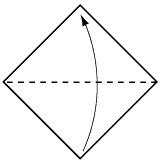
Unfortunately, paper cranes are not the easiest to start with, so I found this Origami Twirling Bird at a website I've used for one of the Math in Your Feet Family Night stations.  Immediately I found myself using math words and concepts as we worked to follow the folding directions. 

"Okay, let's read the instructions," I said. 
"Here it says, 'Start with your paper white side up.  Fold in half, as shown.'"
"Oh look!" I continued, "you fold point to point.  Take the bottom point and fold it up to the top point, but also make sure the edges are matching."

Points and edges!  Whole to half.  Rotate.  Fabulous.  We continue along these lines when, magically, quickly, the bird is done. 

We fly them, and they twirl like fall leaves.  Well, almost; they actually twirl nose over tail like horizontal helicopter seeds.  If they could make a sound they'd be giggling.  Time for lunch.

While I'm in the kitchen Isobel says, a piece of cloth in hand, from the other room, "You could do Origami with fabric!" "Really?" I counter.  "Would the cloth really be able to hold its shape?" There is quiet, and then an exclamation:

"Look Mama!  I can do Origami with my body!"
Body Origami: Paper Crane


Lunch is still not ready.  "Hey Isobel," I say, "Come in here and fly your birds.  Which way are they twirling, do you think?  Nose over tail, or wing over wing?"

Flying ensues. 

I'm still working on lunch and then, spoken rhythmically from the next room,

"Wing over wing does a spinning bird spin?  Ha ha!  Head over heels!"

And there, ladies and gentlemen, is our multi-modal, multi-disciplinary math lesson for the day: a fine motor, gross motor, kinesthetic, auditory, visual, language based and personally expressive math lesson.

Monday, June 20, 2011

Learning Environments: Video Games vs. Making Stuff

It is with very mixed feelings that I have been reading about efforts to create learning environments within the context of video games.  I'm not against using video games as educational tools, necessarily, but I still have this thought in the back of my head:

Why do we need to give kids more screen time then they already have when there are so many more fabulous things they could be doing, like making stuff?

Keith Devlin gave a really worthwhile presentation at the NCTM annual meeting in Indy back in April about the potential of video games in mathematics education and has a new book out on the subject.  He's all for it because gaming is a lifestyle for many kids already -- why not meet kids where they're at with what already motivates them?   His argument (as expressed here) is that well-designed video games "can help develop mathematical thinking, but they are a lot more difficult to design than a simple skills-tester." 

Essentially this means game developers need to think well beyond the basic number skills, factual recall, and symbolic systems that most people think of as 'math' and instead create a game context that engages kids in mathematical thinking and problem solving.  Developing a game like this, Keith says, is unfortunately a huge task with little return on investment and so, until someone comes up with the money, we are relegated to a host of math-fact recall games like this one. 

So, kids like video games, that much is clear.  But, well designed or not, how much more screen time does a kid need??  I read somewhere that many/most kids spend as much time gaming as they do in school (that may have been from Keith Devlin's NCTM talk, actually). My biggest concern, given my commitment to getting kids away from their desks and physically engaged in a thinking/solving/creating process, is that the 'We' with a capital W continue to ignore evidence (and more evidence and a really good argument presenting evidence) that not only do kids need to move more but that...

...real, true comprehension of subject matter and thinking is something that happens in concert between the learner's body, brain, mind, heart and soul.

I recently found something that speaks to all these parts of us called the Tinkering School:

"The Tinkering School offers an exploratory curriculum designed to help kids – ages 8 to 17 – learn how to build things. By providing a collaborative environment in which to explore basic and advanced building techniques and principles, we strive to create a school where we all learn by fooling around. All activities are hands-on, supervised, and at least partly improvisational. Grand schemes, wild ideas, crazy notions, and intuitive leaps of imagination are, of course, encouraged and fertilized."

Gever Tully, who started the Tinkering School, has just described my ideal learning environment for all kids!  A guide, some materials, a few questions, a lot of play, some answers, and then more questions.  So I was thrilled to find his post which approached the issue of video games from my perspective -- as someone who makes things and thinks all kids can benefit from such activity.  Here's what he wrote:
Video games and kids – it’s a complicated issue. On the one hand, I was inspired by games on the Apple II to learn how to program, arguably a seminal period in my life, on the other hand games can clearly seduce the distractible child away from even their own projects. However, I occasionally find these moments where games inspire us to actions we might not otherwise take. Jane McGonigal makes the point that in games we can do the things and be the people we imagine ourselves to be. It seems true, to some extent, but I wonder if habitually playing games slowly changes our definition of success to match the accomplishments programmed into the games (and I appreciate Jane’s work mapping game mechanics onto real life to combat this).  The moment in question today came from Erik’s blog today. His blog offers a plethora of details about everything from zero-carbon houses to Sudbury schools, but I was charmed by this recent entry where he says:
Minecraft and the Tinkering School (it’s a camp) have me inspired to use power tools and knives more with the kids.
Consider that for a moment. The experience of constructing a virtual world inspired him to introduce his children to real tools. Perhaps Jane is right.
In the end, I have no answers and no final opinion, just the hope that we can all maintain perspective about the rush to use video games in education just because kids 'like' to play them.  For now, at least, kids still have bodies that need to move and are well worth harnessing in the pursuit of learning.  We also need to find many more opportunities to help kids be in charge of their own learning.  Certainly, one feels in charge in a gaming environment but, as Gever says, success comes within the confines of the programmed game structure.  Real life is much more open ended and complicated and for these reasons there's nothing more empowering than mastering the unpredictability of life by learning to make your own stuff.

LinkWithin

Related Posts Plugin for WordPress, Blogger...